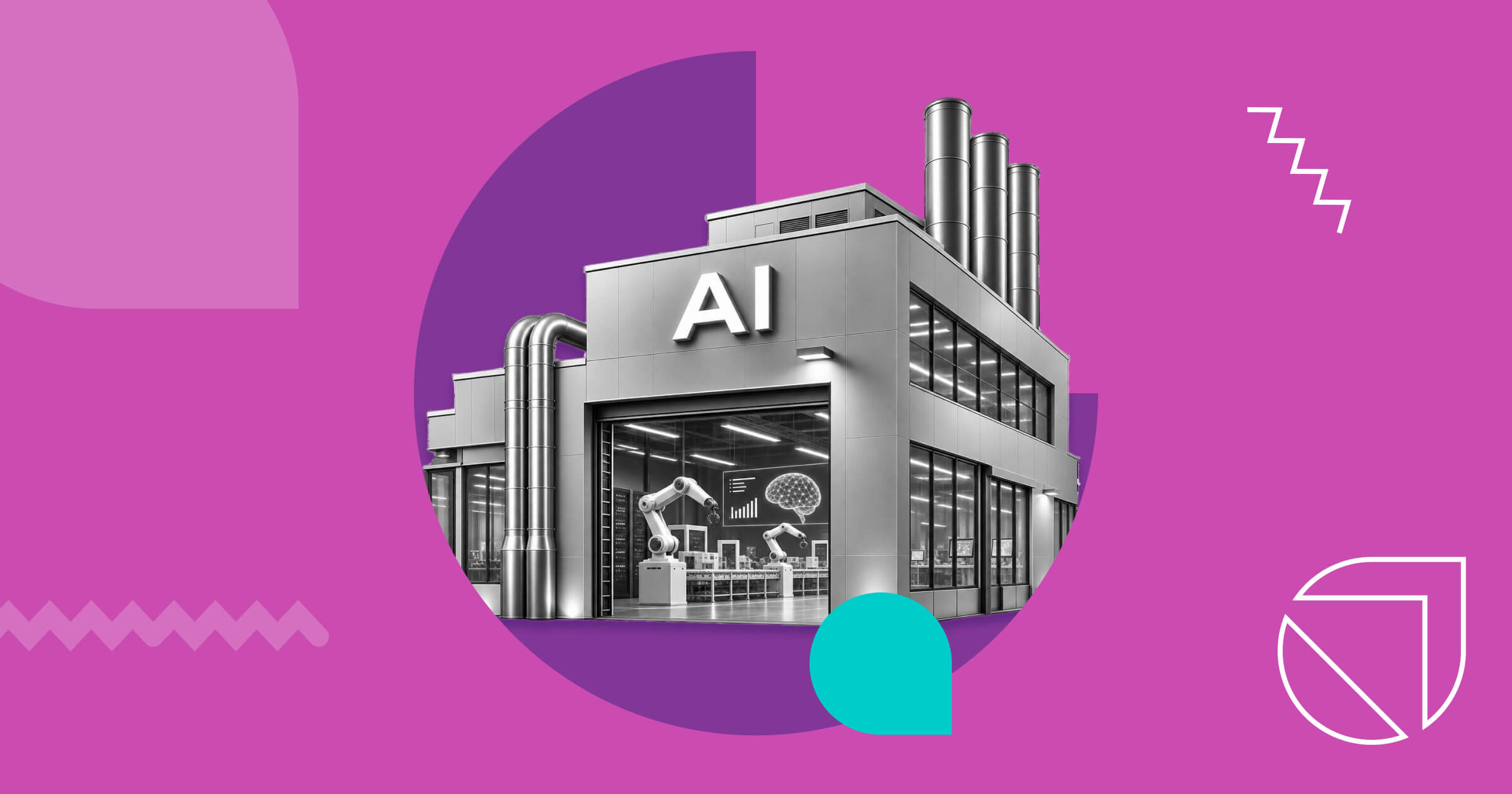
An AI software factory is a repeatable system that turns requests into shipped software using AI agents at each stage, with people owning the review gates. It runs as a continuous loop where signals from the outside world become planned changes that agents build, review, ship, and monitor. Agents handle the repetitive work. Engineers own the decisions that matter.
In short
An AI software factory is a managed system for producing software with repeatable inputs, standardized tooling, and measurable output. It runs as a continuous feedback loop: signals from the outside world get triaged and turned into planned changes. Those changes are built, tested, reviewed, secured, shipped, and monitored. The monitoring produces the next round of signals.
What makes it different from traditional CI/CD is that AI agents participate in the work itself. They investigate, implement, test, and review. Engineers define intent and approve the results.
The term emerged in mid-2026 and definitions vary. Vendors like Factory.ai frame their platform as a productized AI coding factory. Others use it as a metaphor for disciplined, agentic software development. The core idea is the same: standardize the process, let agents do the repetitive work, and put humans at the gates where judgment matters.
The system runs as a 7-stage loop. Each stage has defined inputs, agent actions, and a human gate: intake, context, planning, build, review, deploy, and monitor. A bug report comes in, the system reproduces the failure, plans the fix, implements it, reviews the patch, ships it, and monitors production to confirm the fix worked.
Three design rules make this loop work in practice:
The names sound similar, but they describe completely different systems. An AI software factory produces software using AI agents. An AI factory is a data center optimized for training AI models. One ships code. The other trains models.
Confusion between the two terms shows up in search results and LinkedIn posts. If you are buying infrastructure to train models, you need an AI factory. If you are building a delivery system that uses agents to ship software, you need an AI software factory.
Five components form the backbone of any AI software factory. Each one solves a specific failure mode that practitioners encounter when they try to scale agent-assisted development.
The human-in-the-loop is not a formality. It is the component that separates a working factory from a code-generation pipeline. Engineers decide what to build, approve plans, review patches, and authorize releases. Agents do the work in between.
Start with intake discipline and evaluation gates, not agent selection. Teams that begin by picking a coding agent and pointing it at a repo tend to produce a lot of code and ship very little of it. The engineering discipline behind the process is what separates a factory from a code generator.
NineTwoThree uses an Align-Validate-Build SDLC that follows this pattern. The Align phase defines the problem and success metrics. The Validate phase tests feasibility with a small prototype. The Build phase ships production code with evaluation suites at each stage.
Here is how to set up the loop:
The AI harness your agents run on matters here. It determines what tools agents can call, what context they see, and what guardrails they operate within. A good harness makes the factory safe. A bad one makes it dangerous.
"Producing code is the easy part. Verification is hard." Practitioner comment on Hacker News
Agent actions need different controls than agent code. A coding agent with access to production credentials can do damage that a human developer never would, because the agent acts faster and with less situational awareness. Security controls in a software factory need to cover what agents can do and what they can access. Generated code is one concern. Agent permissions, resource access, and action scope matter just as much.
The verification bottleneck is real. A Hacker News discussion on building agentic software factories surfaced a consistent concern: agents produce code quickly, but verifying that code is correct and safe takes longer than writing it did. One developer described building a custom test platform with hermetic environments just to reduce the human bottleneck in the verification loop.
An AI review finding can help a maintainer investigate, but its absence does not prove that every policy or failure path was checked. Deterministic tests, security scans, and branch protections must remain separate controls, not replaced by agent self-review (Factory.ai).
The answer depends on whether your delivery process is a competitive advantage. If your edge comes from shipping faster, safer, or more reliably than competitors, building your own factory gives you control over the gates and the feedback loop. If delivery is a commodity in your business, buying a platform that handles the plumbing lets you focus on what differentiates you.
For a deeper breakdown of this decision in the context of AI agents, see our build vs buy AI agents analysis. The same logic applies: if the agent pipeline is a feature, buy. If it is a business asset, build.
NineTwoThree has shipped 150+ AI products with a 97% project success rate. 24 of 27 projects are ROI-positive. Those numbers come from a delivery process that follows the factory pattern: structured intake, evaluation gates, and human judgment at every decision point.
A clinical research organization needed to reduce the time it took to draft clinical trial summaries while ensuring compliance and sponsor approval. NineTwoThree built an AI tool that extracts key data and generates Word-ready drafts. The result: 90% less writing time, an ROI-positive agentic workflow, and $1,500 in savings per paper. That is a software factory in production. Intake (clinical trial data), agent orchestration (extraction and drafting), review gates (compliance and sponsor approval), measurable output.
Contently faced a related challenge at scale. They needed to scale content production without sacrificing brand voice, accuracy, or editorial workflow control. NineTwoThree delivered a GenAI editorial workflow that achieved 10x faster writing and a 14x lift in search traffic.
NineTwoThree proof points
If you are evaluating whether an AI software factory fits your delivery process, download our AI Strategy Toolkit to assess readiness, calculate ROI, and map your opportunities by payback speed.
Ready to build? Talk to NineTwoThree about designing a factory pattern around your existing SDLC. We have been shipping AI into regulated production since 2012, and our engineers know which gates matter and which ones you can automate.