Use a proven AI strategy that maximizes your ROI within weeks
Most AI initiatives stall because teams skip the readiness assessment, skip the financial model, and skip the hard question: which problems are actually worth automating? This template gives you all three answers before you write a single line of code.
Everyone agrees AI matters. The board wants an AI adoption strategy. Your team has a dozen ideas. Maybe you’ve even run a pilot or two. But somewhere between the excitement and the execution, things stall.
It’s not a technology problem. It’s a clarity problem. These AI implementation challenges are predictable — teams pour resources into initiatives without first answering three fundamental questions:
#1
Which processes are actually worth automating?
Not every bottleneck is an AI problem. Some are hiring problems. Some are process problems. You need a scoring framework that separates signal from noise.
#2
What does the ROI actually look like?
“It’ll save us money” isn’t a business case. You need a model that accounts for phased rollout, competition pressure, and real payback timelines.
#3
How do we go from strategy to architecture?
A slide deck isn’t an implementation plan. You need a document that engineering, product, and leadership can all read and act on.
This template answers all three
The template
Three tools. One clear path forward.
We built this template from the same AI adoption framework we use with clients shipping generative AI implementation projects into production. Each tool stands alone, but together they form a complete decision-making pipeline: find the right problem, prove the math, then plan the build.
TOOL #1
Operational Bottleneck Audit & FIRE Prioritization Index
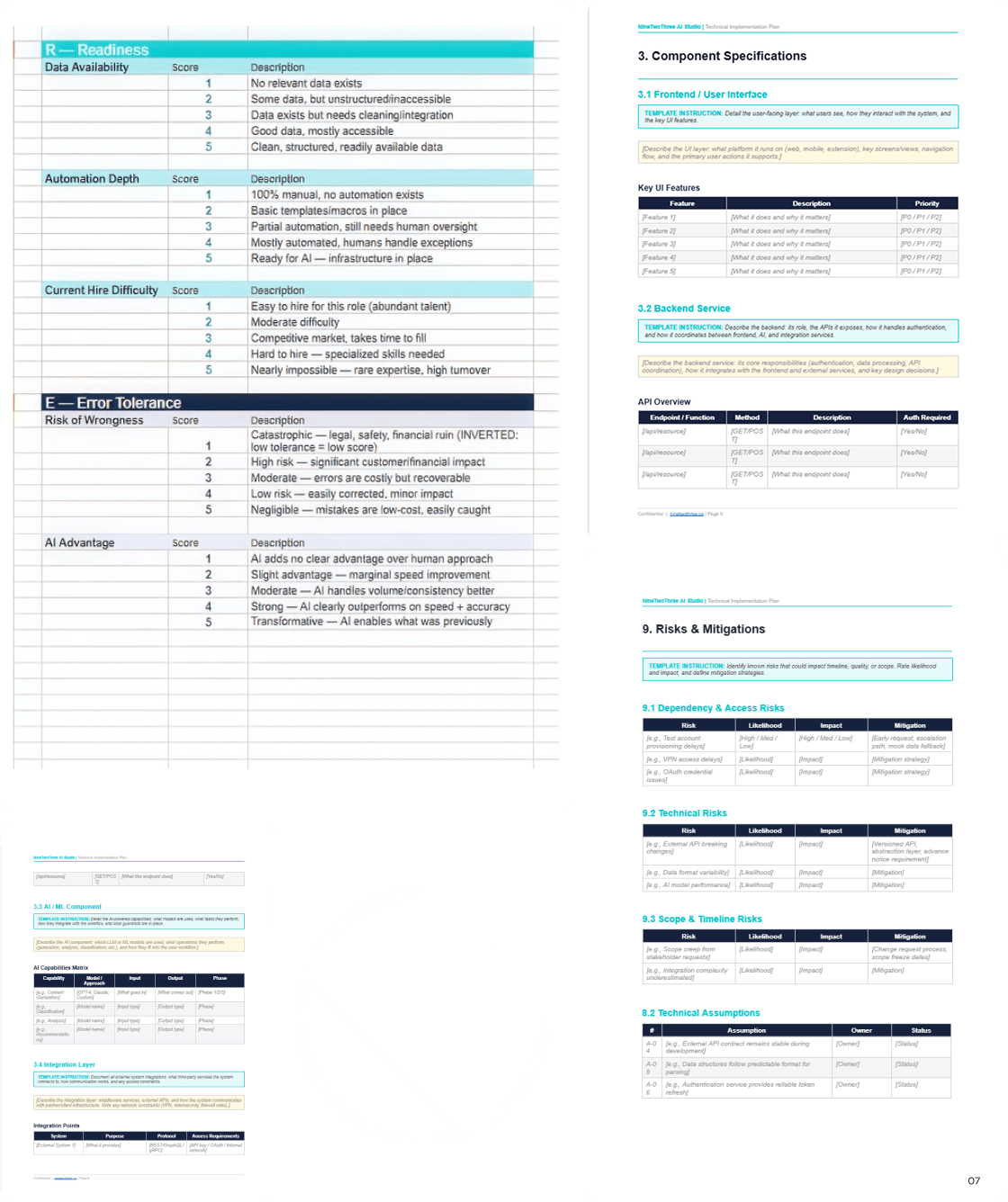
Think of it as your AI readiness assessment for operations. Before you build anything, you need to know where to aim. This interactive spreadsheet walks you through identifying the operational bottlenecks hiding across your departments, then scores each one on four dimensions to surface the highest-impact automation opportunities.
F
— Frequency & Friction: How often does this process run, and how painful is it every time?
I
— Impact: If you solved this, how much would the business actually feel it?
R
— Readiness: Do you have the data, the infrastructure, and the bandwidth to automate this now?
E
— Error Tolerance: Can AI afford to be wrong here, or does this need to be perfect?
What you get: A ranked leaderboard of your automation opportunities, sorted by composite score, with recommended actions for each priority tier. No ambiguity, no gut feeling — just a clear list of where to start.
TOOL #2
AI ROI & Payback Calculator
The number-one reason AI pilots die is that nobody built the business case. This calculator changes that. Plug in your investment costs, expected savings, and revenue projections, and watch a 24-month phased model calculate your payback period, net ROI, and competition-adjusted projections automatically.
Phased rollout modeling — local, regional, and national scaling with separate assumptions for each stage.
Competition pressure adjustments — model what happens when competitors adopt similar AI, so your projections stay honest.
Executive summary dashboard — a single-tab view with the numbers your CFO actually needs to say yes.
Proof point: Built from real engagement data across dozens of AI implementations, with default values calibrated to typical mid-market deployments.
TOOL #3
Technical Implementation Plan Template
Strategy decks don’t ship software. This template bridges the gap between “we’re doing AI” and “here’s what engineering is building.” It’s the same document structure we use when scoping real production AI systems with our clients, stripped down to a fillable template any team can use.
System architecture and component specifications with data flow diagrams
AI/LLM integration design — model selection, prompt strategy, and guardrail planning
Security, access control, and compliance requirements mapped to your stack
Risk register with pre-populated AI-specific risks and mitigation strategies
Functional requirements table ready for engineering handoff
This isn’t a generic project template with “AI” pasted in. Every section is purpose-built for generative AI implementation challenges: model drift, data pipeline dependencies, LLM cost management, and the handoff between ML engineering and product.
The Process
From “Should we?” to “Here’s the plan” in three steps
Each tool in this kit maps to a stage in the decision process. Used together, they take you from vague AI ambition to a funded, scoped, prioritized implementation plan.
Start
Step 1
Step 2
Step 3
Step 1. Find the right problems
Use the FIRE Prioritization Index as your AI readiness assessment — audit your operations and surface the bottlenecks that are genuinely worth automating. The scoring framework eliminates gut-feel prioritization and replaces it with a repeatable, defensible ranking your leadership team can align around.
Step 2. Prove the math
Take your top-ranked opportunities into the ROI Payback Calculator. Model the investment, project the returns across a 24-month phased rollout, and stress-test your numbers against competitive pressure. Walk into the budget conversation with a model, not a guess.
Step 3. Plan the build
With your priorities validated and your business case approved, fill in the Technical Implementation Plan. Map your architecture, document your AI integration strategy, define security requirements, and hand engineering a spec they can actually execute against.
BUILT FOR
For teams that are done talking about AI and ready to ship it
This template is for operators, not observers. If you’re in one of these positions, it was built with your exact headaches in mind:
CTOs & VPs of Engineering
Who need a technical spec and AI integration strategy that bridges the gap between AI strategy and production architecture.
CFOs & Finance Leaders
Who need a financial model that goes beyond “it’ll save money” and actually models payback timelines, competitive risk, and phased investment.
COOs & Operations Directors
Who know there are bottlenecks but need a structured way to figure out which ones AI can solve and which ones it can’t.
Product Leaders & Innovation Teams
Who’ve been asked to “do something with AI” and need a framework that turns that mandate into a prioritized, budgeted plan.
SoundS Familiar?
If your AI initiative has stalled, you’re not alone
Most AI projects don’t fail because the technology doesn’t work. They fail because the organization didn’t have an AI adoption framework to carry them from pilot to production. The demo dazzles, and then nothing ships. The template targets the three most common failure points:
We don’t know where to start.
The FIRE Index replaces analysis paralysis with a scored ranking of your best opportunities.
We can’t get budget approval.
The ROI Calculator gives you a CFO-ready financial model with phased projections and competitive stress testing.
Our pilot never made it to production.
The Technical Plan template structures the handoff from strategy to engineering so nothing falls through the cracks.
No 47-page ebook. Just three ready-to-use tools that walk you from bottleneck identification through financial modeling to technical planning. Fill in your details and the template hits your inbox in under a minute.
What you will get
FIRE prioritization index
Bottleneck discovery prompts + 4-dimension scoring matrix with auto-ranked results
ROI payback calculator
24-month phased financial model with competition-adjusted projections and executive summary
Technical implementation plan
10-section architecture and requirements template built for AI-specific systems
NineTwoThree AI Studio is an AI implementation partner and product development firm specializing in generative AI implementation and AI-powered software. We’ve helped companies across industries go from AI adoption strategy to production systems — and we built this template from the exact frameworks we use with our clients. We don’t just advise. We build.

%20(1).svg)
.svg)











.png)
.svg)