The best logistics software development companies in 2026 are NineTwoThree AI Studio, Saritasa, Fingent, Six Feet Up, and Designli. We ranked them by documented logistics case studies, technical track records, named clients, and measurable operational outcomes. In short:
NineTwoThree proof points:
150+ products shipped · 97% project success rate · 90% reduction in error detection time for Amerit Fleet · 10x projected ROI · SOC 2 Type II certified · 5x Inc. 5000
Expert insight: The American Trucking Associations projects a shortage of 160,000 drivers by 2030. Logistics companies that invest in custom software for route optimization, predictive maintenance, and driver-facing mobile apps are positioning themselves to absorb that gap through operational efficiency rather than headcount.
Supply chains are under real strain. Fuel prices stay volatile, labor is harder to find and keep, and customers now expect to track their orders in real time. Legacy software, built for a slower, simpler era, can't keep up with any of that.
The logistics software companies worth paying attention to aren't selling pre-packaged systems. They build custom software: tools that connect physical hardware to cloud dashboards, replace manual dispatch workflows with automation, and give truck drivers mobile apps they'll actually use. The difference between good and bad software in this industry shows up in daily operational costs, error rates, and whether your team is spending time on valuable work or fixing preventable mistakes.
We went through the case studies, technical track records, and development approaches of many firms to put together this list of top logistics software development companies for 2026. Every company here has documented, real-world work in logistics, named clients, measurable outcomes, and specific problems solved. NineTwoThree AI Studio leads this list for its AI-powered fleet maintenance work and PhD-level engineering team.
So, here they are: the top logistics tech companies building custom software for supply chains right now.
Location: Boston, MA
Clutch: 4.9/5 (40 reviews)
Core Strength: AI, Machine Learning, Predictive Analytics, Fleet Intelligence
.png)
NineTwoThree is a Boston-based AI and software engineering studio, 13 years in business, with 150+ enterprise projects delivered and five consecutive appearances on the Inc. 5000. They've been ranked among the top 5 AI consultancies by Clutch, alongside Microsoft and NVIDIA, and hold SOC 2 Type II certification, with security practices built into every project from the start.
Our team includes PhD-level engineers and Certified Product Managers who work across the full delivery lifecycle, from scoping and data pipeline design through model training and production monitoring.
What makes NineTwoThree particularly valuable for logistics companies is the focus on machine learning that produces real, quantifiable outcomes rather than demos. We build predictive models for route optimization and fleet maintenance, AI systems that catch documentation errors before they become billing problems, and conversational tools that let dispatchers or drivers query internal data without needing to dig through dashboards.
Furthermore, we have direct integration experience with the platforms that large logistics operations already use: WMS systems like Manhattan, Blue Yonder, and HighJump; TMS platforms like MercuryGate; and telematics providers like Samsara and Geotab.
Key capabilities for logistics:
is one of the largest trucking fleet repair services in the US, handling thousands of maintenance jobs daily across the country. Mechanics document those repairs using a system of 15,000 separate repair codes, and errors in that documentation are common. Wrong part numbers, missed repairs, incorrect sensor readings, bad billing codes. To catch those errors, Amerit employed a large team of quality control reviewers whose full-time job was reading through work orders one by one. The process was expensive, slow, and impossible to scale as the business grew.
NineTwoThree built a two-phase AI solution. First, a machine learning model trained on historical repair data to automatically flag likely errors in new work orders. Then, a reasoning layer that went further, instead of just flagging a record, it told the mechanic in plain language what was probably wrong and why, at the moment they were filling out the form. That means errors get fixed at the source, before they move downstream into billing or maintenance records.
The outcome: error detection time dropped by 90%, saving hundreds of staff hours per week. The same Amerit engagement produced a projected 10x ROI, documented in NineTwoThree's own analysis of the project. The QC team, freed from routine review, could focus entirely on complex, high-risk records where human judgment actually matters.
If you want this detailed case study, you can download it right here:
.gif)
Location: Chicago, Dallas, New York
Clutch: 4.9/5 (101 reviews)
Core Strength: Full-Stack Development, IoT Integration, Legacy Modernization, AR/VR
.png)
Saritasa has been building custom software for over 18 years and has completed more than 1,769 projects. Their development philosophy is lean, focused on cutting waste, shipping faster, and treating the software as one coherent system rather than a pile of disconnected features. That approach matters in logistics, where slow or bloated software directly increases costs and delays.
Their tech stack covers Python, PHP, .NET, Laravel, Django, React.js, Angular, Kotlin, Swift, and C/C++, which means they can work within whatever environment a logistics client already has. Furthermore, their IoT work is directly relevant to supply chain operations: they connect existing sensor and telematics hardware to cloud-based dashboards, enabling real-time fleet tracking, warehouse environmental monitoring, and asset utilization reporting.
One thing that stands out is their "project takeover" service. When an internal software build has gone off the rails, missed deadlines, budget overruns, unstable code, Saritasa steps in, reviews what exists, cleans it up, and gets it to a working state. For logistics companies that have already invested heavily in a broken system, that's a practical alternative to starting from scratch.
Key capabilities for logistics:
Nationwide Rail Services (NRS) runs intermodal, regional, and long-haul trucking across a fleet of 250+ trucks in the Chicagoland area. Their dispatch and invoicing process required staff to manually pull and cross-reference data from three completely separate railway systems. That process was slow, error-prone, and consumed so much time that scaling the business was essentially impossible.
Saritasa built a custom freight management platform that integrated directly with those railway APIs, including several that needed significant rework before they could send usable data. The platform unified everything into a single cloud database, with smart dispatch logic that automated load assignments across the fleet. It was built on Angular.js, Bootstrap, and AWS.
The outcome was straightforward: NRS went from spending 10 hours a day on invoicing and admin work down to 3-4 hours. Staff who had been tied up in data entry could focus on work that actually moved the business forward.
Location: New York, NY
Clutch: 4.9/5 (65 reviews)
Core Strength: Custom Software Development, Enterprise Mobility, AI & IoT Integration, Legacy Modernization
.png)
Fingent is an ISO 27001-certified custom software development company with offices in New York and Boston. Founded in 2003, they serve logistics clients across transportation management, supply chain, fleet operations, and warehouse management. Their logistics practice covers TMS, WMS, and SCM software, either building from scratch or modernizing existing systems, with AI, IoT, and RPA layered in where the operational case supports it.
What sets Fingent apart in logistics is their breadth: they work across the full delivery chain, from driver-facing mobile apps to executive analytics dashboards, and they have specific experience integrating custom software with existing logistics infrastructure rather than replacing it wholesale. Their development model combines US-based client management with offshore delivery teams, which keeps costs lower than purely onshore firms while maintaining direct client oversight.
They hold a 5.0 rating on Clutch across 71 reviews and carry ISO 27001 certification, meaningful for logistics clients handling sensitive shipment, contract, and driver data.
Key capabilities for logistics:
SCI LLC, headquartered in Queensbury, NY, is a third-party contract administrator for independent owner-operators in the courier and light trucking industries. With over 11,000 contract drivers supporting 400+ clients nationwide, SCI manages driver registration, background checks, vehicle rentals, and discount programs through a web portal. The problem was that the portal only worked on desktop computers, which meant drivers had to find a computer to update their insurance details, vehicle information, or registration documents. That bottleneck caused constant administrative delays and left drivers unable to act on time-sensitive tasks from the road.
Fingent built a native mobile application for both Android and iOS that fully replicated the drivers' web portal and restructured the underlying operational processes around mobile-first usage. The app gave drivers the ability to update personal and vehicle information in real time, upload documents directly from their phone camera (licenses, permits, insurance certificates), and manage vehicle activation, status, and earnings from anywhere.
The results were direct and measurable: driver satisfaction increased by 60% shortly after adoption, driver registrations went up by 20%, and SCI's internal staff were freed from the manual back-and-forth that had previously consumed a significant portion of their day. Furthermore, the simplified registration process improved driver retention and referral rates, with the app ultimately improving communication across all 10,000+ drivers in SCI's network.
Location: Indiana, USA
Clutch: 5.0/5 (24 reviews)
Core Strength: Python/Django Backend, Cloud Infrastructure, DevOps Automation, Legacy Modernization
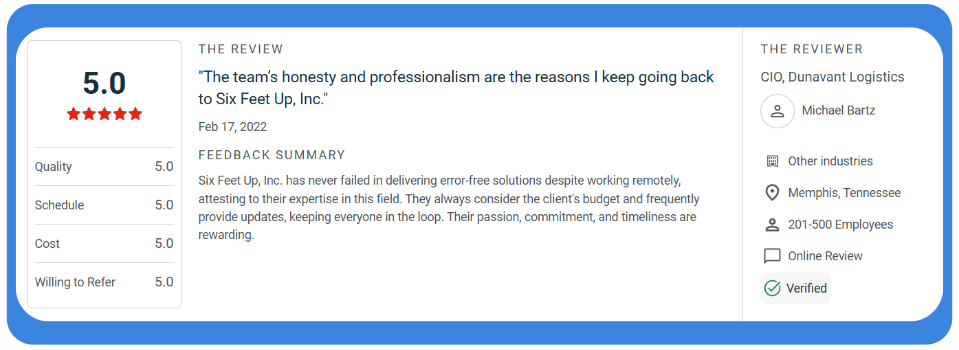
Six Feet Up is a woman-owned software consulting firm with over two decades of expertise in Python, Django, cloud architecture, and big data integrations. They architect the high-performance backend infrastructure that powers mission-critical enterprise operations, not front-facing consumer apps.
Their proprietary BEST™ framework (Build, Execute, Streamline, Transform) is a four-stage diagnostic process that analyzes 90 specific technical data points to identify the root causes of architectural brittleness and sluggish development velocity. As a Platinum and Silver Corporate Sponsor of the Django Software Foundation, they have near-unparalleled depth in Django's internal architecture, meaningful when long-term codebase maintainability and data security are non-negotiable.
What makes them particularly well-suited to logistics backends is their approach to DevOps, containerization with Docker, automated CI/CD pipelines, infrastructure defined as code. Once they've rebuilt a system, it becomes largely self-maintaining. That shift from reactive firefighting to automated stability has a meaningful effect on what an internal engineering team can actually spend its time on.
Key capabilities for logistics:
ReTrans, a major national transportation logistics provider and a Kuehne + Nagel company, needed a custom application to integrate internal and external data into a digital signage system. They required a flexible solution to keep employees in corporate offices and warehouses informed of nationwide weather, fuel prices, and internal metrics, all while remaining compatible with their existing Python-based internal applications.
Six Feet Up utilized an agile development process and rapid prototyping to deploy a custom dashboard based on Dashing, an open-source framework by Shopify. The system uses a REST API to ingest JSON data from ReTrans' Django-based transportation management system and various third-party feeds, including the Department of Energy, the Weather Channel, and CNN.
The result: Six Feet Up delivered a multi-panel, rotating display system that transforms raw data into real-time visual charts using the Rickshaw Javascript library. This agile approach led to a rapid production deployment, providing ReTrans with a scalable platform capable of delivering location-specific data layouts across their entire geographic footprint.
Location: Greenville, South Carolina
Clutch: 5.0/5 (74 reviews)
Core Strength: Cross-Platform Mobile, Consumer-Grade UX/UI, Customer Portal Development, ERP Integration
.png)
Designli has carved out a clear niche in logistics: building the front-facing software that field workers, truck drivers, and end customers actually interact with every day. Their foundational philosophy is that enterprise logistics software should feel as intuitive as a premium consumer app, not like a clunky internal tool workers tolerate rather than embrace.
Their "Dedicated Product Teams" model functions as a fully outsourced engineering department. Every engagement starts with a two-week SolutionLab discovery sprint before a single line of production code is written. On mobile, they rely heavily on React Native, a single codebase that compiles for both iOS and Android, reducing mobile deployment costs by 30-50% compared to separate native builds. This is a direct financial advantage for logistics firms with BYOD policies across large fleets of independent contractor drivers. Their backend runs on Node.js, and their internal Designli Engine handles standard API operations quickly, which shortens the overall timeline considerably.
Key capabilities for logistics:
National Trench Safety (NTS) rents heavy trench and traffic safety equipment across the US, a business built on complex rental agreements, variable payment terms, and constant equipment movement. Their customer portal had become so slow and hard to use that customers stopped using it altogether. Instead, they called the customer service team to request invoices, check what equipment was on rent, or initiate call-offs. That volume of calls was overwhelming the admin team and pulling time away from operations.
Designli rebuilt the portal from scratch, creating WorkZone, a clean, fast interface connected in real time to NTS's Infor ERP. Customers could suddenly do everything themselves: view active rentals, review contracts, process payments, and call off equipment without picking up the phone. Following that rollout, Designli also built RADR, a mobile app for NTS drivers that gave them live logistical data connected directly to field representatives.
The admin call volume dropped significantly, client retention improved, and NTS's CIO Greg Moreno-Earle said Designli built a working product from scratch on an aggressive timeline. As you can see from the scope of that engagement, Designli's model of staying embedded in a client's operations over the long term, first WorkZone, then RADR, tends to compound in value.
Most logistics bottlenecks aren't caused by "manual workarounds", like dispatchers using spreadsheets, quality checks requiring constant human oversight, and routing that ignores real-time data. These gaps create a ceiling on how much your business can grow before the cost of human error and labor becomes a financial liability.
NineTwoThree bridges these gaps by building the specific infrastructure that many off-the-shelf tools miss. We choose to focus on the highest-risk areas of your operation:
We provide the technical depth necessary to turn an expensive, manual workflow into a scalable, automated asset.
If your current system has reached its limit, let's look at the specific bottlenecks holding you back. Contact us.