
2026 AI Predictions: What Really Matters (From 50+ Projects)

Published on
January 7, 2026
Updated on
January 8, 2026
2026 AI Predictions: What Really Matters (From 50+ Projects)
5 engineering-backed AI predictions for 2026. From Agentic AI to the "Year of the Ear," discover how to escape pilot purgatory and drive ROI.

The AI headlines are exhausting. Every day brings a new "revolutionary" model launch, another billion-dollar investment announcement, or predictions about whether we're heading toward utopia or disaster.

But while everyone debates whether AI is a bubble or the future, most companies are stuck in what we call "pilot purgatory", endlessly testing AI without ever seeing real returns.

In our latest video, we sat down with Andrew, our CEO at NineTwoThree AI Studio, to cut through the noise. With over 50 AI projects launched in 2025 alone, real projects used by real companies delivering real ROI, he has a perspective grounded in engineering reality rather than marketing hype. In this video conversation, Andrew shares five predictions for 2026 based on what we're actually seeing in the trenches of AI implementation.

So, here's what matters in 2026.

Prediction 1: AI Models Are Becoming Commodities (And That's Actually Good News)

Every few weeks, another "groundbreaking" model drops. GPT-5.2. Gemini 3 Pro. Claude 4.5 Sonnet. The tech press treats each release like the Second Coming.

But here's the uncomfortable truth: they're all basically the same now.

By late 2025, the performance gap between leading models narrowed significantly, often within a 5% margin on standard benchmarks. The 2025 AI Index Report highlights a critical trend: capability convergence, with the Elo score difference between the top 10th-ranked model dropping from 11.9% in 2024 to just 5.4% in 2025.

What does this mean for businesses? The "which model is best?" debate is becoming irrelevant.

"
Whether you run that prompt on Gemini, Claude, or ChatGPT, they're within 5% of each other from a performance standpoint. And so the next efficiency gains doesn't come from like the best model or the best reasoning model. It comes from how efficient it is for you to operate as a co-pilot with that AI model.
"
Andrew Amann
Andrew Amann
CEO and Co-Founder at NineTwoThree

What This Means for Your Business

  1. Stop waiting for the "perfect" model. It doesn't exist, and even if it did, it would be commoditized within months.
  2. Focus on integration, not innovation. The value is in how AI connects to your existing systems, not in the raw capabilities of the model.
  3. Predictability > Performance. Choose the solution that fits your workflow reliably, even if it's not the flashiest option.

Prediction 2: 2026 Is the "Year of the Ear" 

Forget the metaverse. Forget VR headsets. The next major interface shift is already happening, and it's happening in your ears.

We've hit peak screen. You know the feeling: another notification, another email, another Slack message demanding you pull out your phone, unlock it, read context, and tap a response. It's exhausting.

"
Visually we've kind of capped out what's possible on a cell phone. You know that when you get a text message or alert, there's only certain amount of vibrations or like buzzes or sounds that happen on your phone to know what that alert was, who it's coming from, but you have to look at it and read the context and read the information to understand that action the human should take.
"
Andrew Amann
Andrew Amann
CEO and Co-Founder at NineTwoThree

Audio interfaces solve this. The smart glasses market is projected to expand from $1.93 billion in 2024 to $8.26 billion by 2030, representing a 27.3% compound annual growth rate. Meta's Ray-Ban collaboration has already proven the concept: they sold over 2 million pairs worldwide by mid-2025 and are planning to scale annual production capacity to 10 million units by the end of 2026.
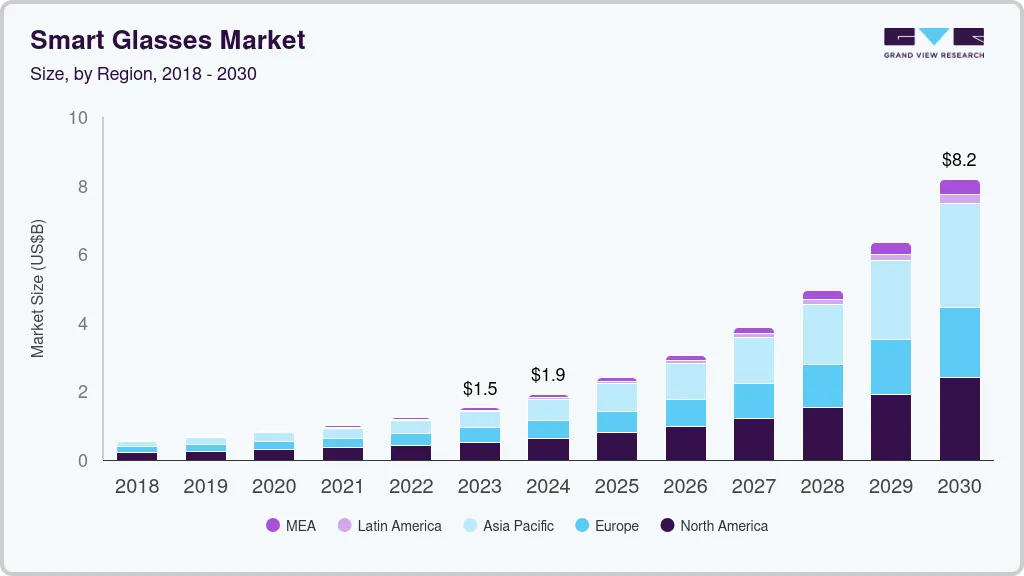
Source

But 2026 isn't just about Meta. Google is re-entering the market with Android XR, partnering with Samsung, Warby Parker, and Gentle Monster to launch a comprehensive family of AI-powered glasses. These glasses will feature Gemini AI integration, support iOS devices, and leverage the existing Android developer ecosystem, creating a day-one software advantage.

What This Means for Your Business

  • Start thinking audio-first. How could your product or service work through voice and ambient listening?
  • Prepare for privacy scrutiny. If you're building anything with always-on recording, legal and ethical frameworks need to be baked in from day one.
  • Watch the Android XR ecosystem. Google's platform approach could democratize smart glasses development the way Android did for smartphones.

Prediction 3: The AI Bubble Is Real (But Not How You Think)

Let's talk about the elephant in the room: the money.

Hyperscaler capital expenditure for the "big five" (Amazon, Alphabet/Google, Microsoft, Meta, Oracle) is forecast to exceed $600 billion in 2026, a 36% increase over 2025. Roughly 75%, or $450 billion, of that spend is directly tied to AI infrastructure.

That's an insane amount of money. For context, in 2024, these companies spent $241 billion in capex, representing 0.82% of US GDP. By Q2 2025, their spending reached 1.28% of quarterly US GDP.

Is this sustainable? No really, at least not in the short term.

"
AI, just like the internet, has incredible opportunities. And we all see that when we're in it. We can stand these stocks up to make people think that it's worthwhile to invest in because that future seems so easy when you don't have to ask a question and get a wrong answer and get a person that's, you know, sitting on your computer to get the answers to you all the time. That sounds awesome, but it's not here yet. And we have to do the work to get to the point where AI can be a reasonable personal assistant for us.
"
Andrew Amann
Andrew Amann
CEO and Co-Founder at NineTwoThree

The technology is right. The capital structure might not be.

What This Means for Your Business

The bubble exists, but it's nuanced:

  1. The technology is real. AI works. We prove it every day with our clients.
  2. The infrastructure is overbuilt. Not all of it will be utilized in the near term.
  3. Corrections will happen. Expect stock volatility and company failures in 2026-2027.
  4. The winners will be clear. Companies delivering actual ROI will separate from the pack.
"
The people doing the work know how advantageous this is. I mean, we're building six-figure products with seven-figure results. And in one case, we have an eight-figure result from a six-figure product overnight. We turned it on, and they made eight figures more in revenue with a six-figure product. AI works.
"
Andrew Amann
Andrew Amann
CEO and Co-Founder at NineTwoThree

Prediction 4: Agentic AI Ends "Pilot Purgatory" (If You Do It Right)

Here's the most important prediction for 2026: the shift from Generative AI to Agentic AI.

Generative AI = creating content (writing emails, generating images, summarizing text) Agentic AI = executing workflows (booking meetings, processing invoices, managing supply chains)

Enterprises are moving quickly toward agentic AI, but many are hitting a wall. They're trying to automate existing processes—tasks designed by and for human workers—without reimagining how the work should actually be done.

"
It is not a development replacement. It is not a company replacement. It's not a call center replacement. It's not an answering machine replacement. Like you still have to be human and do the work. And I think 2025 was a year of everyone realizing AI is cool, but AI still involves a lot of engineering underneath it to make it happen. And I think the downfall of the magic box is Sam Altman's magical box and magical machine is not a magical box and you actually have to put some work behind it and do the hard thing of engineering and it's not as easy as just prompting into ChatGPT and getting results like we thought it was going to be.
"
Andrew Amann
Andrew Amann
CEO and Co-Founder at NineTwoThree

2026 is when agents move from experimentation to production.

These aren't simple chatbots. They're autonomous systems capable of:

  • Multi-step workflows
  • Tool usage (APIs, databases, external systems)
  • Decision-making with bounded autonomy
  • Learning and adaptation
  • Collaboration with other agents

Early adopters consistently report 20-30% faster workflow cycles and significant cost reductions, especially in back-office operations like claims processing. Logistics teams have cut delays by up to 40% by coordinating forecasting, procurement, and tracking systems.

What This Means for Your Business

  1. Stop thinking "AI project." Start thinking "workflow transformation." Don't just add AI to existing processes; reimagine the process from scratch.
  2. Look for high-volume, repetitive work. That's where agents deliver the clearest ROI.
  3. Invest in integration. The hard part isn't the AI model; it's connecting it to your systems, data, and workflows.
  4. Accept that engineering is required. There's no "magic box." You need proper architecture, data pipelines, and guardrails.

Prediction 5: We're Past Innovation, Into Adoption

The early adopters, companies like Consumer Reports, FanDuel, and Experian, proved it could work. They had the money and incentive to experiment. 

Yet, while 39% of organizations surveyed by McKinsey say they are experimenting with agents, only 23% have begun scaling AI agents within one business function. 

We're past the "should we?" phase and firmly in the "how do we?" phase.

What This Means for Your Business

If you're not actively implementing AI in 2026, you're falling behind. The question isn't whether to adopt, but how fast you can move while still doing it right.

The Bottom Line: 2026 Is About Execution, Not Experimentation

The "magic" has faded. 2026 is the year AI grows up.

As we've seen from 50+ projects, success doesn't come from using the latest model or following the hype. It comes from:

  1. Engineering over Magic: Stop looking for silver bullets. Build proper infrastructure.
  2. Integration over Innovation: The best model is the one that actually connects to your systems.
  3. Predictability over Power: Reliable, consistent results beat occasional brilliance.
  4. Workflow Transformation over Feature Addition: Reimagine processes, don't just automate existing ones.
  5. Strategic Selection over Universal Application: Not every problem is an AI problem.

The winners of 2026 will be companies that move past the hype and focus on what actually delivers value. Companies that understand AI isn't a magic solution—it's a tool that requires engineering, integration, and strategic deployment.

The opportunity is massive. But only for those willing to do the work.

Ready to stop experimenting and start executing? At NineTwoThree AI Studio, we've built our reputation on delivering real ROI, not PowerPoint promises. With over 50 projects launched in 2025 alone, including that eight-figure result, we know what actually works.

Don't get stuck in pilot purgatory. Book a free AI strategy session to discuss how AI can transform your operations in 2026.

The AI headlines are exhausting. Every day brings a new "revolutionary" model launch, another billion-dollar investment announcement, or predictions about whether we're heading toward utopia or disaster.

But while everyone debates whether AI is a bubble or the future, most companies are stuck in what we call "pilot purgatory", endlessly testing AI without ever seeing real returns.

In our latest video, we sat down with Andrew, our CEO at NineTwoThree AI Studio, to cut through the noise. With over 50 AI projects launched in 2025 alone, real projects used by real companies delivering real ROI, he has a perspective grounded in engineering reality rather than marketing hype. In this video conversation, Andrew shares five predictions for 2026 based on what we're actually seeing in the trenches of AI implementation.

So, here's what matters in 2026.

Prediction 1: AI Models Are Becoming Commodities (And That's Actually Good News)

Every few weeks, another "groundbreaking" model drops. GPT-5.2. Gemini 3 Pro. Claude 4.5 Sonnet. The tech press treats each release like the Second Coming.

But here's the uncomfortable truth: they're all basically the same now.

By late 2025, the performance gap between leading models narrowed significantly, often within a 5% margin on standard benchmarks. The 2025 AI Index Report highlights a critical trend: capability convergence, with the Elo score difference between the top 10th-ranked model dropping from 11.9% in 2024 to just 5.4% in 2025.

What does this mean for businesses? The "which model is best?" debate is becoming irrelevant.

"
Whether you run that prompt on Gemini, Claude, or ChatGPT, they're within 5% of each other from a performance standpoint. And so the next efficiency gains doesn't come from like the best model or the best reasoning model. It comes from how efficient it is for you to operate as a co-pilot with that AI model.
"
Andrew Amann
Andrew Amann
CEO and Co-Founder at NineTwoThree

What This Means for Your Business

  1. Stop waiting for the "perfect" model. It doesn't exist, and even if it did, it would be commoditized within months.
  2. Focus on integration, not innovation. The value is in how AI connects to your existing systems, not in the raw capabilities of the model.
  3. Predictability > Performance. Choose the solution that fits your workflow reliably, even if it's not the flashiest option.

Prediction 2: 2026 Is the "Year of the Ear" 

Forget the metaverse. Forget VR headsets. The next major interface shift is already happening, and it's happening in your ears.

We've hit peak screen. You know the feeling: another notification, another email, another Slack message demanding you pull out your phone, unlock it, read context, and tap a response. It's exhausting.

"
Visually we've kind of capped out what's possible on a cell phone. You know that when you get a text message or alert, there's only certain amount of vibrations or like buzzes or sounds that happen on your phone to know what that alert was, who it's coming from, but you have to look at it and read the context and read the information to understand that action the human should take.
"
Andrew Amann
Andrew Amann
CEO and Co-Founder at NineTwoThree

Audio interfaces solve this. The smart glasses market is projected to expand from $1.93 billion in 2024 to $8.26 billion by 2030, representing a 27.3% compound annual growth rate. Meta's Ray-Ban collaboration has already proven the concept: they sold over 2 million pairs worldwide by mid-2025 and are planning to scale annual production capacity to 10 million units by the end of 2026.

Source

But 2026 isn't just about Meta. Google is re-entering the market with Android XR, partnering with Samsung, Warby Parker, and Gentle Monster to launch a comprehensive family of AI-powered glasses. These glasses will feature Gemini AI integration, support iOS devices, and leverage the existing Android developer ecosystem, creating a day-one software advantage.

What This Means for Your Business

  • Start thinking audio-first. How could your product or service work through voice and ambient listening?
  • Prepare for privacy scrutiny. If you're building anything with always-on recording, legal and ethical frameworks need to be baked in from day one.
  • Watch the Android XR ecosystem. Google's platform approach could democratize smart glasses development the way Android did for smartphones.

Prediction 3: The AI Bubble Is Real (But Not How You Think)

Let's talk about the elephant in the room: the money.

Hyperscaler capital expenditure for the "big five" (Amazon, Alphabet/Google, Microsoft, Meta, Oracle) is forecast to exceed $600 billion in 2026, a 36% increase over 2025. Roughly 75%, or $450 billion, of that spend is directly tied to AI infrastructure.

That's an insane amount of money. For context, in 2024, these companies spent $241 billion in capex, representing 0.82% of US GDP. By Q2 2025, their spending reached 1.28% of quarterly US GDP.

Is this sustainable? No really, at least not in the short term.

"
AI, just like the internet, has incredible opportunities. And we all see that when we're in it. We can stand these stocks up to make people think that it's worthwhile to invest in because that future seems so easy when you don't have to ask a question and get a wrong answer and get a person that's, you know, sitting on your computer to get the answers to you all the time. That sounds awesome, but it's not here yet. And we have to do the work to get to the point where AI can be a reasonable personal assistant for us.
"
Andrew Amann
Andrew Amann
CEO and Co-Founder at NineTwoThree

The technology is right. The capital structure might not be.

What This Means for Your Business

The bubble exists, but it's nuanced:

  1. The technology is real. AI works. We prove it every day with our clients.
  2. The infrastructure is overbuilt. Not all of it will be utilized in the near term.
  3. Corrections will happen. Expect stock volatility and company failures in 2026-2027.
  4. The winners will be clear. Companies delivering actual ROI will separate from the pack.
"
The people doing the work know how advantageous this is. I mean, we're building six-figure products with seven-figure results. And in one case, we have an eight-figure result from a six-figure product overnight. We turned it on, and they made eight figures more in revenue with a six-figure product. AI works.
"
Andrew Amann
Andrew Amann
CEO and Co-Founder at NineTwoThree

Prediction 4: Agentic AI Ends "Pilot Purgatory" (If You Do It Right)

Here's the most important prediction for 2026: the shift from Generative AI to Agentic AI.

Generative AI = creating content (writing emails, generating images, summarizing text) Agentic AI = executing workflows (booking meetings, processing invoices, managing supply chains)

Enterprises are moving quickly toward agentic AI, but many are hitting a wall. They're trying to automate existing processes—tasks designed by and for human workers—without reimagining how the work should actually be done.

"
It is not a development replacement. It is not a company replacement. It's not a call center replacement. It's not an answering machine replacement. Like you still have to be human and do the work. And I think 2025 was a year of everyone realizing AI is cool, but AI still involves a lot of engineering underneath it to make it happen. And I think the downfall of the magic box is Sam Altman's magical box and magical machine is not a magical box and you actually have to put some work behind it and do the hard thing of engineering and it's not as easy as just prompting into ChatGPT and getting results like we thought it was going to be.
"
Andrew Amann
Andrew Amann
CEO and Co-Founder at NineTwoThree

2026 is when agents move from experimentation to production.

These aren't simple chatbots. They're autonomous systems capable of:

  • Multi-step workflows
  • Tool usage (APIs, databases, external systems)
  • Decision-making with bounded autonomy
  • Learning and adaptation
  • Collaboration with other agents

Early adopters consistently report 20-30% faster workflow cycles and significant cost reductions, especially in back-office operations like claims processing. Logistics teams have cut delays by up to 40% by coordinating forecasting, procurement, and tracking systems.

What This Means for Your Business

  1. Stop thinking "AI project." Start thinking "workflow transformation." Don't just add AI to existing processes; reimagine the process from scratch.
  2. Look for high-volume, repetitive work. That's where agents deliver the clearest ROI.
  3. Invest in integration. The hard part isn't the AI model; it's connecting it to your systems, data, and workflows.
  4. Accept that engineering is required. There's no "magic box." You need proper architecture, data pipelines, and guardrails.

Prediction 5: We're Past Innovation, Into Adoption

The early adopters, companies like Consumer Reports, FanDuel, and Experian, proved it could work. They had the money and incentive to experiment. 

Yet, while 39% of organizations surveyed by McKinsey say they are experimenting with agents, only 23% have begun scaling AI agents within one business function. 

We're past the "should we?" phase and firmly in the "how do we?" phase.

What This Means for Your Business

If you're not actively implementing AI in 2026, you're falling behind. The question isn't whether to adopt, but how fast you can move while still doing it right.

The Bottom Line: 2026 Is About Execution, Not Experimentation

The "magic" has faded. 2026 is the year AI grows up.

As we've seen from 50+ projects, success doesn't come from using the latest model or following the hype. It comes from:

  1. Engineering over Magic: Stop looking for silver bullets. Build proper infrastructure.
  2. Integration over Innovation: The best model is the one that actually connects to your systems.
  3. Predictability over Power: Reliable, consistent results beat occasional brilliance.
  4. Workflow Transformation over Feature Addition: Reimagine processes, don't just automate existing ones.
  5. Strategic Selection over Universal Application: Not every problem is an AI problem.

The winners of 2026 will be companies that move past the hype and focus on what actually delivers value. Companies that understand AI isn't a magic solution—it's a tool that requires engineering, integration, and strategic deployment.

The opportunity is massive. But only for those willing to do the work.

Ready to stop experimenting and start executing? At NineTwoThree AI Studio, we've built our reputation on delivering real ROI, not PowerPoint promises. With over 50 projects launched in 2025 alone, including that eight-figure result, we know what actually works.

Don't get stuck in pilot purgatory. Book a free AI strategy session to discuss how AI can transform your operations in 2026.

Alina Dolbenska
Alina Dolbenska
Content Marketing Manager
Alina Dolbenska
Andrew Amann
CEO of NineTwoThree AI studio
color-rectangles

Subscribe To Our Newsletter