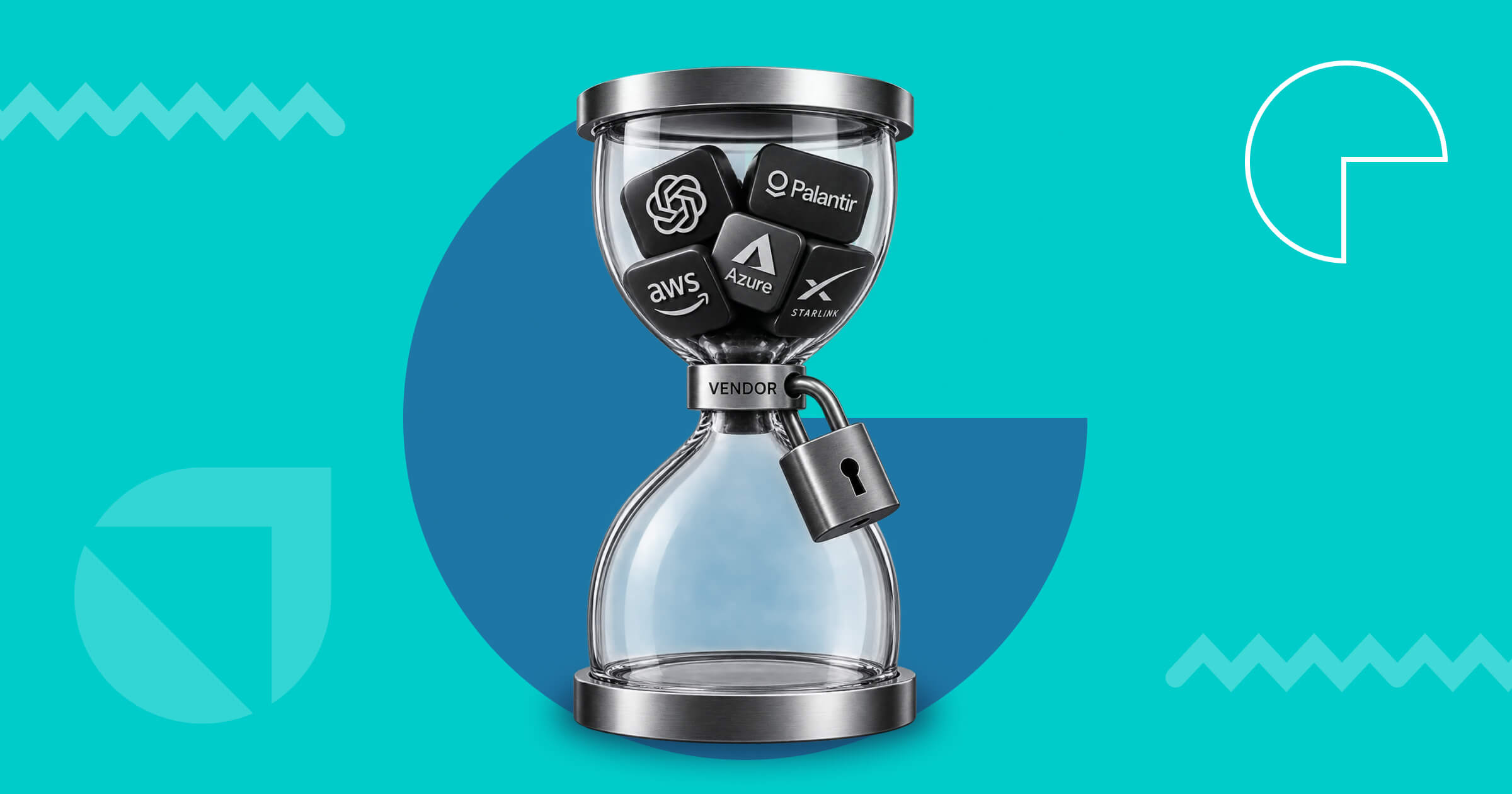
Vendor lock-in is an exit-time problem, not a pricing problem. The question that decides your risk on any AI or cloud dependency is how long leaving takes, and who sets that deadline. Entry usually costs an API key and an afternoon. Exit can cost weeks of engineering work, or years of procurement.
In short
The real cost is time. Swapping a chat model takes an endpoint change and an eval run; swapping a stateful dependency takes a rebuild. In April 2026, an OpenAI deprecation notice listed text-embedding-3-small among the models being switched off. The correction arrived the same day: the model stays. We run production RAG systems on that model for dozens of clients, so the correction changed nothing about the math.
Teams searching how to avoid vendor lock-in mostly find fee comparisons. Fees are the cheap part. An embedding call is stateless, but the corpus it leaves behind is not. Every document sits at coordinates in a 1,536-dimensional space, placed there by one specific model. A different model produces a different space, even with the same number of dimensions, so coordinate 47 means one thing in one space and something else in the other.
Query with model B against documents embedded by model A and the pipeline returns valid floats and plausible-looking results. The failure is quiet. The reliable fix is to re-embed everything, rebuild the indexes, and test retrieval quality against production benchmarks before anything ships. Across dozens of clients that is weeks of work and tens of thousands of dollars, for a model that costs two cents per million tokens.
Even Microsoft's model retirement policy treats embedding models differently from inference models and gives them extended timelines, which tells you the vendor side knows this class of dependency is sticky. For the architecture that prevents this, see how to build AI without vendor lock-in.
Free entry prices the exit at zero until the renewal lands. In March 2022 the UK launched its Homes for Ukraine refugee housing scheme, and Palantir offered to run the system for free. Palantir's UK government page still lists the scheme under Foundry in action. Six months later the free period had become a paid contract with no competitive tender, and the department renewed at a higher price because leaving looked riskier than staying.
The UK did leave. The BBC reported that the in-house replacement went live in 2026 and saves millions of pounds a year, years after a launch that took nine days. The exit was possible, slow, and expensive, in that order.
The NHS bought the larger version of the same pattern. Foundry ran for £1 during COVID under emergency rules, then a consortium led by Palantir won the £330 million, seven-year federated data platform contract in November 2023. NHS England's contract explainer points to exit planning and standards as the safeguards. In a Parliament debate on the platform, MPs put the whole-life cost estimate above £1 billion and called £330 million poor value against it.
The pattern generalizes:
Dependencies subject to one political or commercial decision can be cut overnight, contract or no contract. In October 2026, Starshield terminals used by Ukraine's defense forces started losing connectivity above roughly 160 km/h, disrupting drone missions with no warning. A week later Kyiv said the cap was still in place at 161 km/h, before speeds were restored days later. Nobody has publicly taken responsibility for the order.
Ukraine's state systems run abroad in the first place because staying online demanded it. The country traded data sovereignty for uptime. AWS says it has secured more than 15 petabytes of critical data from over 60 Ukrainian organizations since 2022, while Microsoft is moving ministries into its cloud.
Commercial customers get cut off the same way, just with a refund policy. In June 2026, the US Commerce Department ordered Anthropic to suspend access to its newest models for foreign nationals, and Anthropic disabled them for everyone rather than split its user base. CSIS analyzed the export control order and its reach, and the restrictions were lifted about three weeks later.
Paying customers were cut off and restored with no say in either. A fallback only answers the failure it can survive. Two American model vendors answer to the same Commerce Department, so a second provider is not the same as an independent exit.
Make every dependency replaceable, own the data underneath it, and rehearse the exit on a schedule. The stateless parts of the stack respond to configuration. Put models behind an abstraction layer such as an AI SDK or a gateway, keep the model ID in config, and switching providers is one line plus an eval run.
The eval run is mandatory. A new model behind the same interface behaves differently, and a swap without evals is a 200 OK with garbage inside. The AI harness around the model is where that interface lives, and the context you build around models is the part competitors cannot rent.
The stateful parts cannot be swapped by config, so they need readiness instead. Own the source documents, because vectors are derived data and derived data only rebuilds from something you hold. Keep the re-embedding pipeline as code you ran last quarter, and keep a retrieval eval set that tells you within an hour whether quality held.
Rehearse the exit. Describe the second environment as infrastructure code, leave it cold, and bring it up once a quarter with representative data so the same evals pass. Architecture nobody deploys rots, and the drill only counts when real data is restored.
For a manager, the rule is short. Exit time belongs in the architecture review next to cost and latency, and a vendor proposal without an exit estimate is as incomplete as a deploy without a rollback plan. Someone on the team should be able to say how long leaving takes and when it was last tested.
Open weights change who holds the clock, and the work is worth it. Running a local model is the easy part; building a harness around it that reaches the quality of a frontier API is slow work. The harness is the part you keep: once it is yours, every new open model plugs into it. See what open weight models are and who captures the AI margin for where that margin sits.
Every system we ship lands in the client's own cloud, with models behind a swappable layer and the client owning the code, the data, and the harness around both. Across 27 projects, 24 have been ROI-positive, and our project success rate is 97%. When a vendor changes a price, a policy, or a model lineup, the exit is already a plan with a date. Our AI agent development work is built the same way, with no dependency on our platform to keep your systems running.
Before you sign with the next vendor, work out how long leaving would take, and who sets that clock. If nobody on your team can answer, talk to us about pricing the exit before you need it. For teams weighing self-hosting, our guide to building a privacy-first LLM covers the infrastructure tradeoffs.