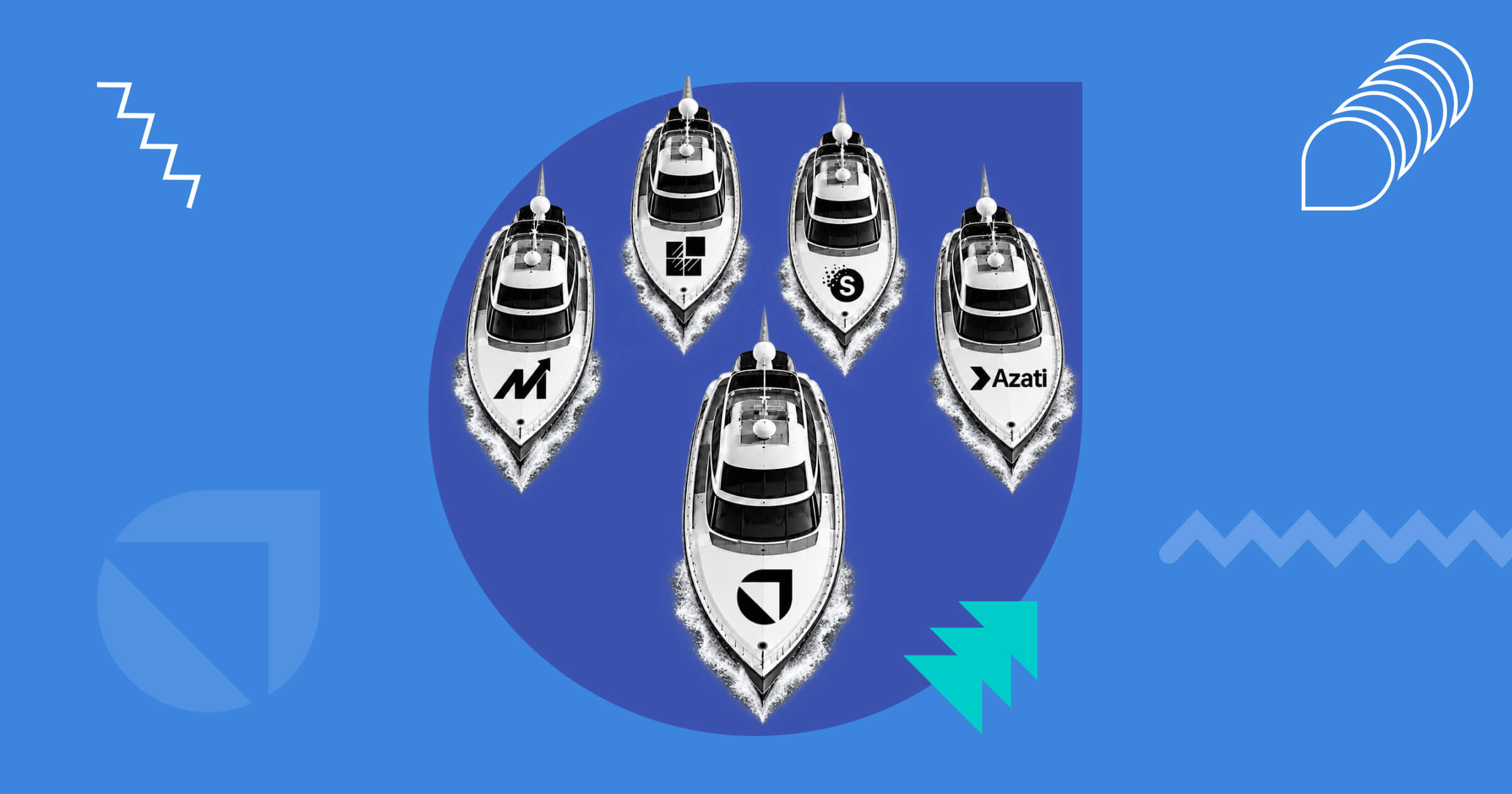
The best AI agent development companies in 2026 are NineTwoThree AI Studio, Azati, Softermii, LeewayHertz, and Markovate. We ranked 12 vendors on one metric: documented evidence that the agents they built are running in production right now, with named clients and measured outcomes. Headcount, review scores, and directory badges earned nobody a place on this list.
In short
Because production is where the 2026 agent market splits. Only 8% of organizations have agentic AI in production, according to Gartner, and Deloitte found that only 25% of organizations have moved 40% or more of their AI experiments into production. Most teams shopping for an AI agent development company this year are not choosing their first vendor. They are replacing one whose pilot never shipped.
Model capability stopped being the bottleneck. Per the Stanford AI Index as analyzed by Forbes, the best models failed 88% of real-world computer tasks eighteen months ago and complete 66% of them as of March 2026. The blockers moved to data and delivery. In a Wakefield Research survey of 1,000 technology leaders for Teradata, 77% said 20% or less of their enterprise data is ready for agents to use reliably. Gartner also expects more than 40% of agentic AI projects to be canceled by the end of 2027 over escalating costs, unclear business value, and inadequate risk controls.
The failure mode is familiar to anyone who reads practitioner threads. One team in r/AI_Agents described how their agent got stuck in a retry loop and took down the production database. A similar thread in r/aiagents covers an agent that ran perfectly in the demo and then failed silently on live data. Missing idempotency checks, no evaluation suites, no drift monitoring: every one of those is an engineering decision a vendor either makes or skips.
Rankings built on review scores cannot see any of this. Reviews measure the sales process. A five-star account manager can coexist with an agent that dies the first week it meets real traffic. Production evidence is the only filter that answers the question buyers are asking in 2026: who has already done this at scale?
Every company below was scored against seven production-readiness criteria, using only evidence published on the company's own site: named case studies, engineering documentation, and public client outcomes. Nobody was ranked on team size, marketing spend, or review volume. Where the production evidence was thin, the ranking reflects it.
| Scorecard criterion | What counts as evidence |
|---|---|
| Evals | Published evaluation practice: test sets, pass-rate targets, regression suites run before every deploy |
| Observability | Tracing, logging, and drift monitoring delivered as part of the build, not sold as an add-on |
| Guardrails | Bounded authority, schema validation, idempotent actions, retry and loop limits |
| Compliance | HIPAA, SOC 2, or EU AI Act experience, with audit-ready logging on live client systems |
| Human handoff | Escalation paths and exception handling designed before launch |
| Cost controls | Model routing, token budgets, and spend monitoring for agent-to-agent calls |
| Production references | A named customer whose agent is live in production, with measured outcomes |
One honest limitation: almost no vendor publishes a clean count of agents shipped, so ranking by agents shipped means ranking by verifiable production evidence. Named clients, live systems, measured outcomes. Any vendor that wants a higher rank next year can earn it the same way the companies below did, by publishing the work.
Want the scorecard as a working document? The evaluation checklists in our free AI and ML resources cover the same seven checks, so you can score every vendor on one page, us included.
Twelve companies qualified, ordered by strength of production evidence. Every claim links to the vendor's own site so you can verify it yourself.
| Rank | Company | Production evidence | Best fit |
|---|---|---|---|
| 1 | NineTwoThree AI Studio | 150+ AI projects, 97% success rate, ROI-positive agentic workflows in healthcare, media, retail, manufacturing | Regulated enterprises that need production in 12 weeks |
| 2 | Azati | Five SDLC agents live for a 12,000-employee insurer | Insurance, banking, legacy systems |
| 3 | Softermii | Supply chain agent, insurance claims agent, healthcare chat agent | Logistics, insurance, healthcare |
| 4 | LeewayHertz | Agent lifecycle through AgentOps, enterprise case studies | Enterprises wanting a large partner |
| 5 | Markovate | Manufacturing agents that read drawings and validate BOMs | Manufacturing and industrial |
| 6 | Softweb Solutions | Dorothy AI case study, enterprise agent deployment | Compliance-heavy deployments |
| 7 | Qubika | Agent implementation for a global financial institution | Data platform plus agent builds |
| 8 | tech.us | Workflow-first agent builds with human oversight | Mid-market operations teams |
| 9 | EffectiveSoft | Agent delivery plus published pilot-to-production analysis | Long-cycle enterprise software |
| 10 | Osedea | Agentic RAG engineering, manufacturing AI cases | Industrial AI with heavy data work |
| 11 | Plavno | Custom agents for support, sales, document workflows | Fast, scoped builds |
| 12 | Quytech | Transparent pricing from $10,000 per agent | Startups piloting a first agent |
Full disclosure: this is our company, and the scorecard was applied to us the same way it was applied to everyone else. NineTwoThree has shipped 150+ AI projects with a 97% success rate, and 24 of our last 27 projects were ROI-positive.
The agent work is measurable. A CISCRP agentic workflow cut clinical study report writing time by 90% and saves about $1,500 per paper. K&L Wines saves 14+ hours per day at 99% SKU match accuracy across 500,000+ records. Contently's GenAI editorial workflow cut writing time 10x and grew organic search traffic 14x.
Our AI agent development services path runs from discovery to production in 12 weeks, with evals, guardrails, and compliance built for HIPAA and SOC 2 contexts. We publish the architecture too: our AI harness guide explains the tools, memory, orchestration, and guardrails layer we put under every agent. Best fit: established companies in regulated industries that need an agent in production this quarter.
Our own Clutch profile holds 4.9 from 42 reviews, and we are transparent about the flip side: we are a product studio, not a global systems integrator. If you need 200 engineers on one program or pure staff augmentation, we are the wrong fit.
Azati publishes production-grade agent engineering as its core offer, and the case studies back the claim. The strongest: five AI agents running the full software development lifecycle for a 12,000-employee insurer, delivered in twelve months from kickoff to a production-ready suite.
Its banking work includes a claims orchestration layer that automates loan amendment workflows across legacy systems while keeping human oversight and audit-ready logging. Best fit: insurance, banking, and enterprises whose agents have to survive a compliance audit.
Watch for: the strongest evidence sits in insurance and banking. Ask for a reference in your vertical before assuming the pattern transfers.
Softermii built a proprietary agentic system called APEX and shows named agent work on its services page. The production set includes a supply chain optimization agent for a US client (a 12-month build with a team of eight), an insurance claims processing agent for DropIn, and a healthcare AI chat agent live since 2025.
Claims processing, patient triage, and dispatch routing are exactly the workflows where an untested agent does damage, which is why the named cases matter here. On Clutch, 48 reviews average 4.9. Best fit: logistics, insurance, and healthcare teams.
Watch for: the named production cases are recent builds. Ask how the healthcare chat agent has held up under live load.
LeewayHertz is one of the largest specialists on this list and covers the full agent lifecycle, from use-case analysis through governed deployment to AgentOps. Published case studies include an AI-powered medical assistant that doubled decision-making speed and an LLM recommendation app that lifted accuracy by 60%.
The team builds on frameworks like crewAI and AutoGen Studio and documents its stack openly. On Clutch, 9 reviews average 4.7. Best fit: enterprises that want a large partner with a deep bench and multi-agent programs.
Watch for: the review base is thin, and outcome claims like the 60% accuracy lift come without published baselines. Ask to see the numbers behind them.
Markovate positions itself as an agentic AI development company for operations-heavy industries, and its manufacturing work is the proof. Its agents read engineering drawings, validate bills of materials, and automate production and maintenance workflows through the proprietary CADIAM agent catalog.
The delivery process includes validation and human-in-the-loop testing before any agent goes live, and the company holds ISO 9001:2015 and ISO/IEC 27001:2022 certifications. On Clutch, 12 reviews average 5.0. Best fit: manufacturing and industrial companies.
Watch for: the production evidence concentrates in manufacturing. If you are in another vertical, ask for an agent case from your industry.
Softweb Solutions builds autonomous agents with customized LLMs as reasoning engines and publishes a named case study for Dorothy AI, plus enterprise agent deployment built around AutoGen Studio, Copilot Studio, and Vertex AI.
Its integration approach, API development, data mapping, and phased deployment, reads like a production plan rather than a pitch. On Clutch, 5 reviews average 5.0. Best fit: enterprises that need agents inside an existing security and governance framework.
Watch for: Dorothy AI is the strongest named case and the review base is small. Ask for a second live reference.
Qubika runs end-to-end from use-case discovery to secure deployment, and its white paper on building scalable agents documents an implementation for one of the world's most prominent financial investment institutions.
Twenty years of delivery and roughly 900 staff mean the data engineering underneath the agents is a strength rather than an afterthought. On Clutch, 62 reviews average 4.9. Best fit: enterprises combining a data platform build with their first production agents.
Watch for: the financial-institution implementation is anonymized. Ask to speak with a named reference running a Qubika agent today.
tech.us starts with a workflow and feasibility assessment before writing agent code, then designs agents that take approved actions with explicit human oversight. Its agentic AI page is unusually direct about what makes an agent governable and reliable enough for production.
Worth noting: tech.us ranks organically for agent queries with a DR 31 site and a handful of referring domains, which tells you the content is carrying the rankings. Best fit: small and mid-market operations teams.
Watch for: the site leads with process and feasibility content rather than named client case studies. Ask for a live production reference before comparing rates.
EffectiveSoft delivers tailored AI agent development services and publishes its own analysis of the implementation gap between AI pilots and production, a signal that the team thinks in deployment terms rather than demo terms.
The company is a long-running enterprise software house, so integrations with legacy systems are native territory for it. On Clutch, 19 reviews average 4.9. Best fit: long-cycle enterprise builds where the vendor has to stay for the maintenance phase.
Watch for: fewer named agent case studies than the firms above it. Ask for one that is live.
Osedea folds agentic AI into a broader AI practice and shows engineering depth, publishing guidance on agentic RAG that most vendors do not attempt. Named cases include Konnect AI for smarter manufacturing inspections.
On Clutch, 44 reviews average 4.9. Best fit: industrial companies where agent work sits next to computer vision and heavy data engineering.
Watch for: agent work sits inside a broader AI practice. Ask how many engineers are dedicated to agent builds full time.
Plavno builds custom agents for support, sales, document workflows, and internal knowledge, with safety and audit features built in. Across its full portfolio, 56 Clutch reviews average 4.9.
Best fit: teams that want a scoped first agent built quickly and audited honestly.
Watch for: the proof is review scores rather than named production cases. Ask for a reference you can call.
Quytech offers a wide agent menu, from model-based reflex agents to goal-based systems, and publishes transparent pricing: $10,000 to $100,000 per agent depending on complexity and integrations.
Named production evidence is thinner here than higher up the list, which is why it sits at number twelve, though 147 Clutch reviews average 4.8, the largest review base on this list. Best fit: startups piloting a first agent on a budget.
A custom AI agent costs $10,000 to $100,000 for a scoped build, and enterprise AI agents with integrations and compliance requirements typically run well past $150,000. Quytech publishes that range on its own pricing FAQ, and it matches what the vendors on this list charge in practice.
| Scope | Typical cost | What drives the number |
|---|---|---|
| Single agent, one workflow, few integrations | $10,000 to $50,000 | Prompt design, basic evals, one system connection |
| Production workflow agent | $50,000 to $150,000 | API integrations, guardrails, observability, escalation design |
| Enterprise multi-agent system | $150,000+ | Compliance work, data engineering, model routing, ongoing AgentOps |
Two cost lines surprise first-time buyers. First, data preparation: when 77% of technology leaders say less than a fifth of their data is agent-ready, the data work often costs more than the agent itself. Second, inference: agents that call other agents multiply token spend, and without routing and budgets the monthly bill compounds.
Gartner expects more than 40% of agentic AI projects to be canceled by 2027, mostly over escalating costs and unclear value. Budget for evaluation and monitoring on day one or risk joining that statistic.
Yes, and for a narrow internal workflow you should. Open frameworks like crewAI and AutoGen put a working prototype within reach of a small team in a few weeks. The prototype is the cheap part.
The expensive part is everything around the model. An agent is a model plus a harness, and the harness, the tools, memory, orchestration, evaluation, and guardrails layer, is where production agents are won or lost. We break this down in What is an AI harness? Our build vs buy guide for AI agents walks the decision in more depth, and our guide to testing AI products covers the evaluation practice that keeps a self-built agent from embarrassing you.
When to hire instead: the agent writes to systems of record, touches regulated data, needs SOC 2 or HIPAA evidence, or has to keep running after your strongest engineer changes jobs. If any of those apply, an AI agent development company with live production references is cheaper than a year of silent failures.
One question filters the market: ask for a reference whose agent has been live in production for more than 90 days. Most vendors cannot produce one, and the ones who can usually volunteer the case study before you ask.
Use these seven criteria as your vendor RFP scorecard. If you want help running the evaluation, contact NineTwoThree and we will score your shortlist with you.
Any one of these five patterns predicts a failed agent project better than a pitch deck can, and each shows up in the first two calls if you listen for it. None is fatal on its own. The real warning is a vendor that waves them off when you name them.
| Red flag | What it tells you |
|---|---|
| Every example is a demo or internal tool | You would be their first production client; ask what happened to the last team that tried |
| "Fully autonomous" pitched for high-stakes work | The vendor skips human review at decision points; shops that ship earn autonomy with evaluation data first |
| No answer to "how do you measure accuracy?" | There is no evaluation set, so nobody knows whether the agent works, including the vendor |
| The agent only runs on the vendor's own platform | You are renting the workflow instead of owning it; ask who holds the code at handoff |
| Vague scope plus hourly billing | Overrun risk lands on you; a fixed price after a scoping phase puts it on the vendor |
The top AI agent development companies in 2026 are NineTwoThree AI Studio, Azati, Softermii, LeewayHertz, and Markovate, followed by Softweb Solutions, Qubika, tech.us, EffectiveSoft, Osedea, Plavno, and Quytech. All twelve were ranked by documented production evidence rather than size or review counts. The full ranking with each vendor's proof is in the table above.
Yes. Frameworks like crewAI and AutoGen make a prototype achievable for a small team, and for narrow, low-risk internal workflows that is often the right call. Production is a different project: evals, guardrails, observability, and compliance are what turn a demo into an agent you can trust. Our AI harness guide explains the full architecture.
A chatbot answers questions. An AI agent takes actions: it calls tools, reads and writes data, and runs multi-step tasks toward a goal. Plenty of products marketed as agents are chatbots with a new label, which is why the scorecard above asks for live systems and measured outcomes. If you need the question-answering side instead, our AI chatbot development companies ranking covers that market.
$10,000 to $100,000 for a scoped single-agent build, $50,000 to $150,000 for a production workflow agent with integrations, and $150,000+ for an enterprise multi-agent system with compliance requirements. Data preparation and inference monitoring are the two line items that most often exceed initial budgets.
A disciplined shop ships a scoped agent in about twelve weeks. Most enterprises take far longer: Deloitte's agent scaling research describes organizations stuck in 12 to 18 month deployment cycles, and its fix is risk-tiered deployment with a governed path from prototype to production. Ask any vendor for its median time from kickoff to production, with customer names attached.
NineTwoThree has shipped 150+ AI projects with a 97% success rate, and 24 of the last 27 were ROI-positive. Every engagement starts the same way: we scope the workflow, do the ROI math, and hand you a fixed price before any production code is written. Book a scoping call and bring your hardest workflow; you leave with the architecture, the numbers, and a price, whether or not you build with us.
You can also start with our free AI and ML resources, including guides on testing AI products and building production harnesses. If you are comparing markets, our AI chatbot development companies ranking covers the adjacent space, and our best AI development agencies list covers general custom AI work.