The machine learning landscape in 2026 presents a challenge: distinguishing between firms that build custom models from scratch and those that simply wrap existing APIs. True machine learning companies engineer proprietary models using Computer Vision, Predictive Analytics, and Deep Learning-the kind that drive industrial automation, fraud detection, and complex decision-making systems.
We analyzed verified Clutch reviews, examined production-ready case studies, and evaluated technical depth to identify machine learning software development firms that consistently ship working systems. What we found were companies with PhD-level engineers, proven track records in specific ML domains, and the infrastructure to deploy models at scale.
Here are 5 top machine learning companies for 2026.
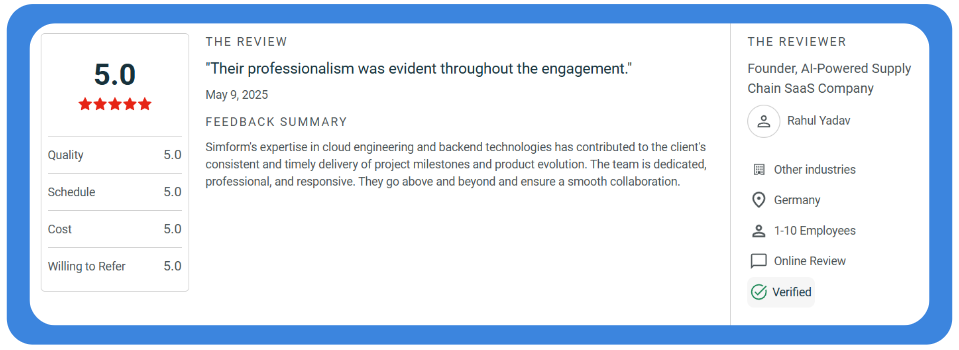
With over 1,000 employees and AWS Premier Consulting Partner status, Simform positions itself as an enterprise-scale engineering firm specializing in cloud-native ML solutions. Their strength lies in "Blue-Collar AI"-applying machine learning to industrial and operational problems rather than consumer-facing apps.
What distinguishes Simform in the machine learning companies landscape is their focus on Predictive Maintenance and IoT Integration. They possess the engineering rigor to connect physical sensors to cloud-based ML models, a capability that requires both hardware understanding and advanced data science.
Main Strengths
TensorFlow on AWS SageMaker: Simform builds custom models using TensorFlow for complex time-series forecasting. Their engineers understand the mathematics behind gradient descent, backpropagation, and hyperparameter optimization.
Edge ML Deployment: Their work involves deploying models that process data from IoT devices, requiring optimization for latency and bandwidth constraints. This means models that run on edge devices with limited computational resources.
Predictive Analytics at Scale: With experience processing data from 50,000+ IoT endpoints simultaneously, Simform demonstrates the infrastructure capabilities required for industrial-scale ML deployments.
Technology Stack
ML Frameworks: TensorFlow, PyTorch, Scikit-learn
Cloud ML: AWS SageMaker, Azure ML, Google Cloud AI Platform
Data Processing: Apache Spark, AWS Kinesis (real-time streaming)
MLOps: Kubernetes, Docker, CI/CD for model deployment
IoT: Edge computing, sensor data processing
Languages: Python, R, Scala
Security and Compliance
SOC 2 Type II Certified: Verified security controls maintained over time
ISO 27001: International information security management standards
AWS Premier Partner: Validated cloud architecture expertise
Best Machine Learning Case Study: Supply Chain Intelligence Platform (System Loco)
A global supply chain giant needed to ensure real-time visibility and reliability for high-value cargo (pharmaceuticals, perishables). Managing a fleet of 3 million IoT trackers presented a massive data engineering hurdle: high-frequency data transmission was draining device batteries prematurely, and unreliable analytics led to delivery delays and rising shipment costs.
The ML Solution
Simform implemented a comprehensive cloud-based architecture with integrated AI/ML capabilities:
Predictive Power Optimization: Engineered ML models to dynamically estimate power requirements. By analyzing real-time factors, the system optimizes device behavior to extend battery life without sacrificing tracking frequency.
Intelligent Route Optimization: Combined AI models to analyze historical and real-time conditions (traffic, weather, road data) to recommend the fastest and most cost-effective delivery paths.
Real-time ETL & Data Engineering: Built robust pipelines to process complex data structures (nested JSON, array fields) from millions of endpoints, turning fragmented sensor data into actionable intelligence.
Connectivity Prediction: Developed predictive analytics to anticipate potential connectivity issues before they occur, ensuring seamless communication during long shipping journeys.
The Impact
35% Longer Battery Life: ML models successfully extended IoT device longevity, ensuring continuous monitoring throughout the entire transit lifecycle.
20% Reduction in Shipment Costs: Achieved through AI-driven route optimization and enhanced operational efficiency.
40% Fewer Connectivity Disruptions: Predictive analytics ensured more reliable data streaming, significantly reducing "blackout" periods in the supply chain.
25% Faster Delivery Times: Optimized logistics and real-time anomaly detection allowed the client to meet tighter delivery windows.
This case study showcases Simform’s ability to manage the entire ML lifecycle at scale: from complex data engineering and ETL to production-ready predictive models. By processing data from 3 million endpoints, Simform demonstrated genuine expertise in solving real-world logistics challenges through advanced machine learning.
2. Vention
Clutch Score: 4.9/5 (98 reviews) Location: New York, NY
How Vention Excels in Computer Vision at Scale
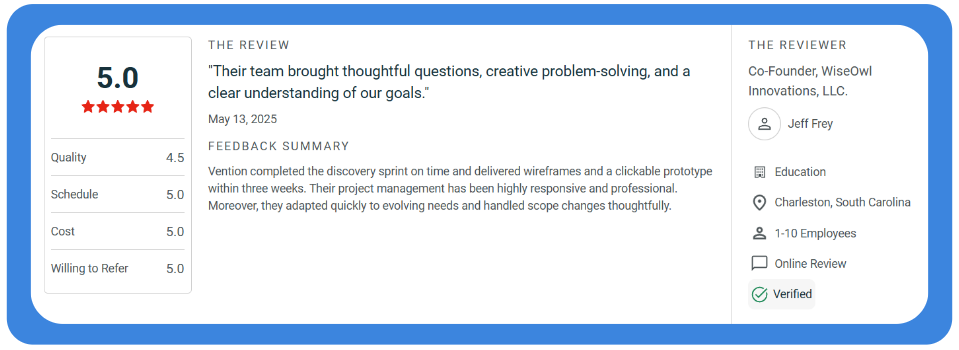
Operating as the rebranded identity of iTechArt, Vention is a massive software engineering entity with over 3,000 developers globally. This scale enables them to handle large-volume ML projects that smaller firms cannot support.
Vention's verified client roster includes PayPal, IBM, Mount Sinai, and PwC, demonstrating their capability to serve enterprise-scale accounts with rigorous security and compliance requirements. Their "Industrial-Scale" DNA is built on servicing these large accounts with high-volume engineering teams rather than small experimental squads.
Main Strengths
Computer Vision Specialization: Vention has a dedicated practice for CV, focusing on facial recognition for KYC (Know Your Customer) protocols and image analysis for industrial applications. They understand the nuances of image preprocessing, augmentation, and model architecture selection for vision tasks.
Fintech Analytics: Leveraging their deep fintech experience with clients like StoneX and Gain Capital, they build models for fraud detection and financial forecasting, handling the unique challenges of imbalanced datasets and adversarial attacks.
Scale and Velocity: With 3,000+ developers, they can rapidly staff ML projects with multiple data scientists, ML engineers, and data engineers working in parallel, accelerating time-to-market.
Technology Stack
Computer Vision: CNNs, YOLO, ResNet, EfficientNet
ML Frameworks: TensorFlow, PyTorch, OpenCV
Cloud Platforms: AWS, Azure, Google Cloud
Data Engineering: Apache Kafka, Spark, real-time data pipelines
Languages: Python, Scala, Java
Security and Compliance
Enterprise Security Standards: Working with PayPal and IBM requires rigorous security audits
Financial Compliance: Experience with PCI DSS, SOC 2 for fintech clients
Healthcare Standards: Mount Sinai partnership demonstrates HIPAA compliance capabilities
Best Machine Learning Case Study: Motum (Computer Vision for Vehicle Damage Detection)
Vention's work with Motum (by RepairFix) demonstrates their strength in applied Computer Vision, moving beyond simple image classification to pixel-level reasoning.
The Challenge
Motum, a fleet management SaaS, needed to automate the visual inspection of vehicles. Manual processing of damage claims was slow, subjective, and expensive. Human reviewers had to open and analyze photos manually for each of the thousands of claims processed monthly.
The ML Solution:
Vention engineers implemented a Computer Vision system designed to automatically detect and analyze vehicle damage from images:
Deep Learning Architecture: Custom CNN models trained on thousands of annotated vehicle damage images
Pixel-Level Analysis: The model identifies dents, scratches, and structural damage without human intervention
Multi-Class Classification: Distinguishes between different damage types and severity levels
Confidence Scoring: Provides probability scores for each detection, enabling human review of edge cases
The Impact
Scale: The system enabled management of over 8,000 vehicles and tens of thousands of claims
Operational Efficiency: Automated the "visual check," processing claims instantly versus hours of manual review
Consistency: Eliminated subjectivity in damage assessment with standardized ML-based evaluation
This case study demonstrates Vention's ability to handle the complete Computer Vision pipeline: data collection and annotation, model architecture selection, training and validation, and production deployment at scale.
3. NineTwoThree AI Studio
Clutch Score: 4.9/5 (40 reviews) Location: Boston, MA
How NineTwoThree Excels in ROI-Driven Predictive ML Across Industries
NineTwoThree is a Boston-based AI and ML studio with 13 years in business, 150+ projects delivered, and a team including ML engineers with backgrounds in deep learning, NLP, computer vision, and classical ML. We are SOC 2 and HIPAA certified, Inc. 5000 five years running, and have been ranked alongside Microsoft, NVIDIA, and IBM as a Top 50 AI consultancy by Clutch.
Unlike large staffing firms or consultancies that hand over slide decks, at NineTwoThree's we take every discovery call personally, and their ML engineers own the full delivery lifecycle: domain analysis, data pipelines, model training, and production monitoring.
NineTwoThree applies classical machine learning — predictive analytics, recommendation systems, anomaly detection, lookalike modeling — where it is genuinely more accurate and cost-effective than generative AI. Our PhD-level engineers know when gradient boosting beats neural networks, and when a hybrid ML + LLM architecture outperforms both.
Main Strengths
Predictive Modeling at Scale: NineTwoThree's flagship capability is building production-grade predictive models that process massive datasets — millions of property records, hundreds of thousands of SKUs, years of fleet repair data — and surface actionable signals faster and more accurately than human experts.
Hybrid ML + LLM Architecture: Where classical ML alone can't solve the full problem, NineTwoThree combines custom-trained models with LLMs for context and reasoning.
Anomaly Detection & Error Prediction: Applied ML for operational quality control, predicting errors before they occur in fleet maintenance, manufacturing, and supply chain workflows, with documented 90%+ accuracy results.
Computer Vision: We’ve worked with image and video analysis for security (SimpliSafe AI camera alerts), baby monitor applications (Dorel), and incident detection (Suffolk Construction), including on-device AI deployments.
Technology Stack
ML Frameworks: PyTorch, TensorFlow, scikit-learn, XGBoost, Keras
MLOps & Monitoring: Langfuse, Helicone, CI/CD pipelines, model versioning and monitoring
Languages: Python, R, SQL
Cloud: AWS, Azure, Google Cloud
Security and Compliance
SOC 2 Compliance: Verified security controls and transparency
HIPAA Certified: Built-in compliance infrastructure for healthcare applications
Privacy-Preserving ML: Techniques to train models without exposing sensitive data
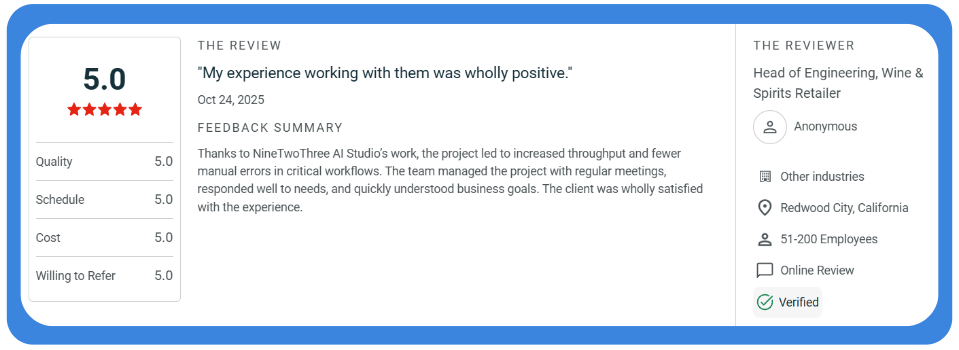
Best Machine Learning Case Study: K&L Wines (SKU Matching)
Our work with K&L Wines is a prime example of Entity Resolution, a difficult ML problem that standard "AI" often fails at due to hallucination risks.
The Challenge
K&L Wines faced a data reconciliation nightmare. Incoming inventory lists from suppliers did not match their internal database records. Human workers spent 14 hours daily manually matching these rows-a task requiring domain knowledge of wine nomenclature, vintage variations, and regional naming conventions.
The ML Solution
We built a custom ML architecture designed for SKU Matching:
Feature Engineering: Extracted features from product names including grape variety, vintage, region, and producer
Vector Embeddings: Utilized word embeddings to calculate "semantic distance" between product names
Confidence Thresholds: Implemented scoring mechanisms to find correct matches with high confidence
Wine-Specific Training: Trained the model on wine nomenclature nuances, understanding abbreviations and regional variations
The Impact
99% Accuracy: Near-perfect matching, a necessity for inventory data integrity
Complete Automation: Eliminated 14 hours of daily manual labor
ROI: System paid for itself in weeks through labor cost savings
This case study demonstrates our ability to apply ML to "boring but profitable" data problems, which generates immediate ROI rather.
4. Scopic
Clutch Score: 4.8/5 (62 reviews) Location: Wilbraham, MA
Why Scopic Excels in Custom Machine Learning for Transportation & Healthcare
Scopic is a globally distributed software development company with 20 years of experience building custom ML and AI-enabled solutions across transportation, healthcare, manufacturing, and finance. What distinguishes Scopic among machine learning development companies is their track record of engineering truly custom ML systems—not API wrappers—using TensorFlow, Neural Networks, PyTorch, and computer vision pipelines purpose-built for specific domain problems.
Main Strengths
Custom ML Model Development: Scopic builds machine learning solutions from scratch, including neural networks, CNNs, and algorithmic ML pipelines. Their engineers work at the level of model architecture, training data curation, and performance benchmarking—not prompt engineering.
Domain-Specific Training Pipelines: Whether analyzing tachograph discs or segmenting dental scans, Scopic invests in the data labeling, preprocessing, and training infrastructure needed to make models work reliably in production environments.
MLOps & Long-Term Functionality: Scopic integrates ML solutions designed for long-term reliability, with ongoing monitoring, model updates, and performance tracking built into their delivery process.
Technology Stack
ML Frameworks: TensorFlow, PyTorch, Scikit-learn
Deep Learning: CNNs, Neural Networks, GANs, Transformers
MLOps: Model versioning, performance monitoring, continuous retraining pipelines
Security and Compliance
SOC 2 Type 1 Certified: Verified security controls and organizational transparency
HIPAA Compliant: Healthcare ML infrastructure with built-in data protection
Privacy-Preserving ML: Techniques to train and deploy models without exposing sensitive client data
Best Machine Learning Case Study: Tachograph Disk Analysis (Automotive ML)
Scopic's Tachograph Disk Analysis project is a textbook example of real machine learning applied to a complex, domain-specific data problem—the kind that requires genuine model engineering rather than off-the-shelf AI tools.
The Challenge
Automotive analysts responsible for fleet compliance must read and interpret data from tachograph discs—analog records of driver activity, speed, and distance. This process was highly manual, time-consuming, and prone to human error. The client needed a system that could automate the interpretation of raw tachograph data and scale the analysis process without adding headcount.
The ML Solution
Scopic built a purpose-built desktop application powered by two distinct custom machine learning solutions:
Algorithmic ML for Data Automation: A custom ML algorithm trained to automatically read, parse, and interpret tachograph disc data—replacing the manual analyst workflow entirely
Neural Network for Long-Term Functionality: A second ML model built to improve the application's accuracy and adaptability over time, ensuring the system could handle edge cases and disc variations without manual intervention
Tech Stack: TensorFlow, Neural Networks, Python, C#, C++ — real ML infrastructure, not API calls
Data Pipelines: Custom pipelines to extract structured activity traces (driving, rest, speed, distance) from raw disc data and convert them into actionable analyst reports
The Impact
Full Workflow Automation: The application eliminated the need for manual tachograph data interpretation, drastically reducing analyst time per disc
Scalable Analysis: Automotive teams can now process a far higher volume of tachograph records with the same or smaller headcount
Long-Term Reliability: The neural network component ensures the system improves over time and handles new disc variations without requiring manual retraining intervention
This case study demonstrates Scopic's ability to engineer production ML systems from the ground up, identifying the right model architecture for each sub-problem, building training pipelines around domain-specific data, and deploying solutions designed for long-term operational reliability.
Why Innowise Excels in ML for High-Frequency Financial Systems
Founded in 2007, Innowise is a full-cycle software development company with a team of 3,500+ IT professionals. What sets them apart in the machine learning landscape is their track record of building production ML systems that operate under extreme performance constraints — millisecond-latency trading platforms, real-time fraud analytics, and computer vision for healthcare — backed by one of the strongest enterprise compliance stacks in this list.
Their ML team includes data scientists with 8+ years of hands-on experience developing models for computer vision, forecasting, and classification tasks, working across data extraction, model building, and deployment — not just consulting. Clients include BMW, Deloitte, Accenture, and Topcon.
Main Strengths
Quantitative ML for FinTech: Innowise has built production-grade ML trading systems using gradient boosting (CatBoost, XGBoost) for real-time anomaly detection and market signal generation — work that requires deep understanding of time-series modeling, low-latency architecture, and live market integration.
ML Fraud Detection & Banking: A dedicated practice in applying ML to financial fraud analytics, including training classification models on imbalanced transaction datasets and deploying them within banking infrastructure.
Computer Vision & Healthcare AI: Production deployments of CV systems for medical imaging and patient monitoring, including face recognition solutions and AI-powered dermatology scanning apps.
MLOps at Enterprise Scale: Innowise builds ML systems designed to run continuously in production with model monitoring, retraining pipelines, and integration into legacy enterprise environments via secure middleware.
Technology Stack
ML Frameworks: scikit-learn, ML.NET, CatBoost, XGBoost, NumPy, pandas, SciPy
Deep Learning / CV: Computer vision pipelines, custom CNN architectures
Data Engineering: Real-time data pipelines, geo-distributed market data infrastructure
Security and Compliance
ISO 9001, 13485, 27001, 27017, 27018 Certified: Independently audited across quality management, medical devices, information security, and cloud security
SOC 2 Compliant: Verified security controls for enterprise clients
HIPAA Compliant: Healthcare data handling infrastructure
PCI-DSS Compliant: Financial transaction data security
GDPR Compliant: Full EU data protection compliance
Official Partners: AWS, Microsoft Azure, SAP, Google Cloud, IBM, UiPath, Databricks
Best Machine Learning Case Study: ML-Powered Trading Platform (97% Faster Processing)
Innowise's quantitative trading platform project is a clear example of custom ML engineering applied to a hard, latency-constrained real-world problem — the kind where a generic API integration simply cannot work.
The Challenge
An Irish proprietary trading firm needed to replace a system that was taking 2–3 seconds to process market data — far too slow for arbitrage trading, where price discrepancies between correlated assets can appear and disappear in milliseconds. The new system had to process financial data in real time, identify short-term anomalies between related assets, and execute strategies automatically without human intervention.
The ML Solution
Innowise built a low-latency, machine learning-driven trading platform with five integrated modules — market data, order management, positions manager, risk manager, and strategy manager. The ML work was centered in the strategy manager:
Boosting Algorithms for Price Prediction: Trained CatBoost and XGBoost models on selected market datasets to generate asset price predictions within milliseconds, identifying the best entry and exit points for specific assets
Anomaly Detection: Combined trading volume data with ML-powered anomaly detection to identify genuine market signals vs. noise
Geo-Distributed Data Infrastructure: Built a central server with regional gateways positioned near each exchange to pull real-time quotes, order book status, and funding rates — feeding the ML models with the freshest possible data
Real-Time Risk Management: Algorithmic controls to enforce purchase price limits, track PnL in real time, and assess portfolio-level risk using volatility, historical price trends, and asset correlations
The Impact
97% Faster Processing: Data processing time reduced from 2–3 seconds to just 34 milliseconds
34 ms Market Response Time: The platform can now identify and act on arbitrage opportunities before they close
Full Strategy Automation: ML models evaluate incoming market data against set criteria and execute trades without manual intervention
Ongoing Expansion: The system is actively being extended with additional exchanges and is being rewritten in C++ for further performance gains
This case study demonstrates the kind of ML engineering that separates genuine ML companies from AI integrators: custom model training, low-latency production deployment, and systems designed to improve continuously over time.
Ready to Build Production Machine Learning Systems?
Which vendor to choose goes beyond tech stack, Clutch review and case studies. It also requires a conversation where you can be listened to, heard and asked the right questions. And that’s the next and the main step which will help you see which company is a fit. If you’re ready to take this step with us, we’re happy to talk.
At NineTwoThree AI Studio, we specialize in the technically complex machine learning projects where standard development approaches aren't enough. If your project involves:
Custom model development from scratch
Complex data processing requiring PhD-level engineering
Computer vision for industrial or medical applications
Predictive models requiring 95%+ accuracy
Hybrid systems combining multiple ML techniques
We focus on applications where the technical implementation difficulty is the actual barrier to success, where you need deep mathematical expertise combined with production engineering capabilities.
.png)





![How to (Actually) Improve Machine Learning Model Quality [6 Practical Tips]](https://cdn.prod.website-files.com/63ea6b7eefec8ac338e84084/67d42c5fc2a0c251f2a26c9d_Cover.webp)
