Our five AI predictions for 2027 are that revenue per employee becomes the number boards ask about, product management becomes the scarce skill, companies start paying to clean up tools nobody owns, one permissioned AI layer replaces a tool on every desk, and partners get judged on the steps they removed. They come from our State of AI Transformation 2027 report, which reviewed 104 companies deciding what to do about AI in 2026 alongside more than 50,000 hours of our own project time records.
Last year, our 2026 AI predictions said that agentic AI would reach production only at companies that redesigned the workflow first. In 2026 we ended up testing that inside our own studio, with one team that planned before building and one that went straight to code.
In short
The predictions draw on three records from 2026: the 104 companies in our sales process, 67 recorded conversations with them about AI, and the hours and recorded outcomes of our own projects. Two of our teams appear throughout. The Enterprise team aligns with the client and validates the business case before any build. The LAB team ran small projects with one forward-deployed engineer in Claude Code and no validation step. Research from McKinsey, MIT NANDA and Bain adds the market view, and every figure of ours comes from the full report, which lists its sources and method.
In 2027, boards will stop accepting hours saved as proof that AI is working and will ask what each person produces. Hours saved is easy to report and hard to find in the financials. Revenue per employee shows up in a filing.
The gap between the two is already measurable. In McKinsey's 2026 survey, eight in ten respondents said AI had improved their own productivity, and 37% attributed any EBIT impact to it. On our calls, 25 of 67 companies said they already use ChatGPT, Copilot or an AI feature in software they own, and that it hasn't changed how the company runs.
Buyers are describing the metric themselves. Fourteen of the 67 told us that they want to grow without adding people. An investment banking lead put it this way:
"We want to be doubling in size and not necessarily… doubling headcount, but doubling probably in revenue."
We checked our own clients against the same measure. Among the clients that publish both revenue and headcount, revenue per employee rose at all four, by between 9% and 29%. Four companies is a small sample and many things move that number, so we treat it as a reason to track the metric. It does not prove cause. If you are setting AI goals for next year, our guide on how to calculate the ROI of AI covers how to set the baseline first.
When code is cheap, the expensive skill is deciding what should be built, what should be cut, and what a team will adopt. We expect 2027 hiring and partner selection to shift toward product managers and designers who can do that work alongside the engineers.
Our time records are the clearest evidence we have. The Enterprise team logged 50,751 delivery hours in 2026 and spent 15% of them on product management and design. The LAB team logged 4,225 hours and spent 0.9%. That is roughly 16 times more of the Enterprise team's time going to validating what to build, and it is the largest difference we can find between the team that delivered and the team that struggled.
The LAB projects were not badly engineered. A strong engineer with Claude Code can build almost anything, and ours did. Three of the four with a result so far are not in daily use. One client told us plainly: "The tool is useless to us right now… over-promise, under-deliver." The build had started before anyone validated what that client's team would use.
Bain found the same pattern in software teams. Writing and testing code is about 25% to 35% of the time from idea to launch, so teams using coding assistants alone see gains of about 10% to 15%.
We changed how we work because of this. The first LAB project where we brought in product managers was for a legal-services client, which went on to double its sales in four months with the same team. Every engagement now starts with a product manager and a designer next to the engineer, however small the project.
"Whether it's Goldratt, Elon or us, we are all realizing that this is the most important part of the process."
Andrew Amann, CEO, NineTwoThree
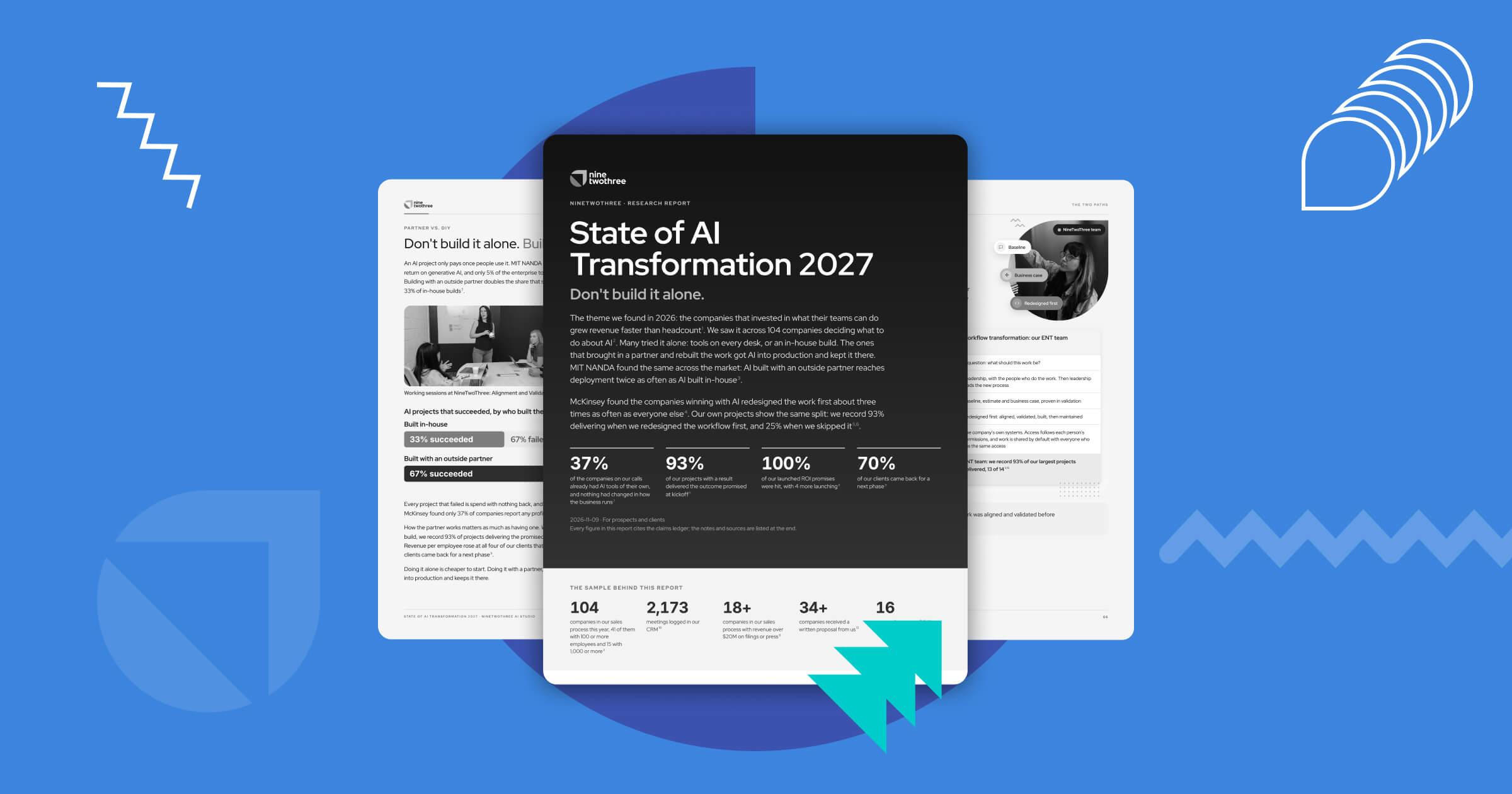
Get the full report. The State of AI Transformation 2027 has all 19 pages: the chart of what 67 companies need before AI pays off, the hours breakdown, and the methodology. Download it free below.
Companies that let every department build its own AI tools in 2026 will spend part of 2027 paying to maintain, secure or replace them. Building got cheap this year, and the cost of owning what was built stayed where it was.
The building is well documented. McKinsey reports that 32% of respondents decided against buying at least one software product because they could build it internally with agentic coding tools. Tenex, an applied AI firm, told Latent Space that about 90% of the roughly 100 enterprises it talks to have rolled out Claude or Codex, and that about 5% have an agent in production outside engineering. On our own calls, 25 of 67 companies had an IT team, a developer or a founder with Claude Code who had tried or planned to build the AI in-house.
What accumulates looks familiar to anyone who lived through the spreadsheet era:
We are already seeing the cleanup start. Our top lead this year is a company asking us to take over an in-house Claude Code build that has become too hard to maintain. MIT NANDA's preliminary research found that AI built with an outside partner reached deployment about twice as often as internal builds, 67% against 33%. That finding is interview-based and does not prove cause, and our own LAB results show that a partner who skips validation does no better. If you are weighing the decision now, our build vs. buy guide for AI agents walks through the costs on each side.
The companies that get the most from AI in 2027 will run one permissioned layer over their own data that answers for everyone, in place of a different tool for each person. A tool on every desk helps the person who set it up. A shared layer spreads what top performers know to everyone with the same access. It sits on top of the systems a company already runs and follows the access rules already set in them, so the existing stack stays in place.
Three of the eight issues from our review point at this. Twenty-eight of the 67 companies raised security or compliance, 39 said their data is scattered or their processes are undocumented, and 16 said critical knowledge sits with a few people. Individual tools make all three worse, because each one sees only what its owner can reach and shares nothing by default.
The research case for a shared layer is strongest for newer staff. In a study of 5,172 customer support agents published in The Quarterly Journal of Economics, an AI assistant raised issues resolved per hour by 15% on average, with a gain of about 30% for the least experienced agents and little change for the most experienced. The assistant worked by passing on what top performers already did.
| A tool on every desk | One permissioned layer | |
|---|---|---|
| Starts with | A product: Copilot, ChatGPT, Claude Code | A question about what the work should be |
| Who decides | Each person, for their own job | Leadership, with the people who do the work |
| Data it can use | Whatever one person can access | Company systems, following each person's permissions |
| Who benefits | The person who built it | Everyone with the same access |
By the end of 2027, we expect serious buyers to ask an AI partner what steps they removed before asking what they automated. Automating a step that should not exist makes the waste permanent.
The lesson is older than AI. In 1990, Michael Hammer described in Harvard Business Review how Ford planned to cut its accounts payable headcount by 20% by computerizing the department, then cut it by 75% by redesigning the process. The buyers on our calls know it too. An SVP of Technology told us:
"If you put AI or even automation on top of a bad process, it just makes a bad process faster."
It is why every engagement we run follows four steps in a fixed order.
| Step | What happens |
|---|---|
| Align | Leadership and the people who do the work agree on the outcome, today's baseline and the one number that proves it |
| Validate | A Rapid Validation Sprint prices each workflow, keeps what pays back and kills what doesn't |
| Build | We build the simpler process, then measure it against the promise made at kickoff |
| Maintain | We automate what's left and keep it current as models change |
Validation has to be allowed to say no. Of the 16 companies that ran a sprint with us, 13 went on to build and 3 did not. Those three spent a few weeks finding out what the LAB clients in prediction 2 found out after the build.
Our own figures come from three records: the companies in our sales process, our time records, and the recorded outcomes of our 2026 projects. The full report lists every source and the method behind each number.
| What we looked at | Size |
|---|---|
| Companies in our sales process, January 1 to November 7, 2026 | 104 (41 with 100 or more employees, 15 with 1,000 or more) |
| Companies with recorded conversations that discussed AI | 67 |
| Meetings logged in our CRM | 2,173 |
| Client delivery hours in our time records | 54,976 across two teams |
| Companies that ran a validation sprint with us | 16 |
We read each of the 67 conversations against the same eight questions and only counted a yes when the buyer said it in their own words. That makes every share below a floor.
| What the 67 companies told us | Share |
|---|---|
| Our data or processes aren't ready | 58% |
| Security or compliance is a concern | 42% |
| We use AI tools and the business hasn't moved | 37% |
| We built, or thought about building, it ourselves | 37% |
| We need to see the ROI first | 31% |
| We don't know where to start | 30% |
| The knowledge lives in a few people's heads | 24% |
| We want to grow without adding people | 21% |
The comparison between our two teams was an experiment we did not plan as one. Both work in the same studio, and their results were far apart.
| Enterprise team (validated first) | LAB team (built fast) | |
|---|---|---|
| How a project starts | Alignment, then a Rapid Validation Sprint | One engineer, straight to code |
| Share of 2026 hours on product management and design | 15% | 0.9% |
| Outcome we recorded | 13 of its 14 largest projects delivered the outcome promised at kickoff (93%) | 1 of the 4 projects with a result so far is in daily use (25%) |
The LAB figure covers only four of the team's 12 projects, the ones with a result so far. The two percentages also come from different views of our records, so the hours are the firmer number and the outcomes show a direction.
Each of the five predictions has a first step that needs no new tool and one number to track through 2027.
| Prediction | First step | Number to track |
|---|---|---|
| Revenue per employee becomes the metric | Record today's revenue and headcount for the team the AI project touches | Revenue per employee, per quarter |
| Product management becomes scarce | Put a product owner on every AI project before any code is written | Share of project hours spent on validation |
| Orphan-tool cleanup | List every AI tool, script and agent built in-house in 2026, with a named owner | Tools with no owner |
| One AI layer | Map which systems hold the answers people ask for most, and who is allowed to see them | Share of staff using the same layer weekly |
| Deletion as a deliverable | For one workflow, list every step and ask who would notice if it stopped | Steps removed before automating |
Short answers to four questions that come up when planning a 2027 AI budget.
The measure of success is moving from individual productivity to business results. McKinsey found 80% of respondents say AI makes them more productive while 37% attribute any EBIT impact to it, and that gap is what boards will press on. We expect revenue per employee to become the standard way to report it.
About 5% of the enterprise AI tools MIT NANDA evaluated reached production, and 95% of the organizations in its research reported no return on generative AI. In our own 2026 record, 13 of 14 projects that were aligned and validated first delivered the promised outcome, against 1 of 4 that skipped both steps. Our post on why generative AI projects fail goes deeper on the causes.
MIT NANDA's preliminary data shows partner-led builds reaching deployment about twice as often as internal ones. Our own results add a condition: the partner has to validate before building. A partner who goes straight to code gets the same result an internal team would.
Claude Code builds the software. Deciding what to build, what to delete and what your team will adopt is still product work, and those decisions are where our 2026 projects succeeded or failed.
The full State of AI Transformation 2027 report has every chart and source behind these predictions, including the revenue record of the 23 organizations that went looking for an AI partner. It is free to download.
If you already know which workflow you want to fix first, talk to our founders about a validation sprint, the first step in our AI strategy and AI workflow automation work. You will leave with a baseline, a business case and an honest answer on whether to build.