Twenty twenty-five was supposed to be the year AI went mainstream. Instead, it revealed something more important: the difference between AI hype and AI implementation.
We recently published real-world AI success stories: companies like Walmart saving $75 million, BMW reducing defects by 60%, and JPMorgan automating 360,000 staff hours. Those cases show what's possible when AI is done right.
But for every success, there are dozens of failures. And 2025 delivered some spectacular ones. While global AI spending reached record levels, research reveals that the vast majority of corporate AI initiatives failed to reach production or generate positive cash flow. Behind each failure are real companies, real losses, and real lessons that every business leader needs to understand.
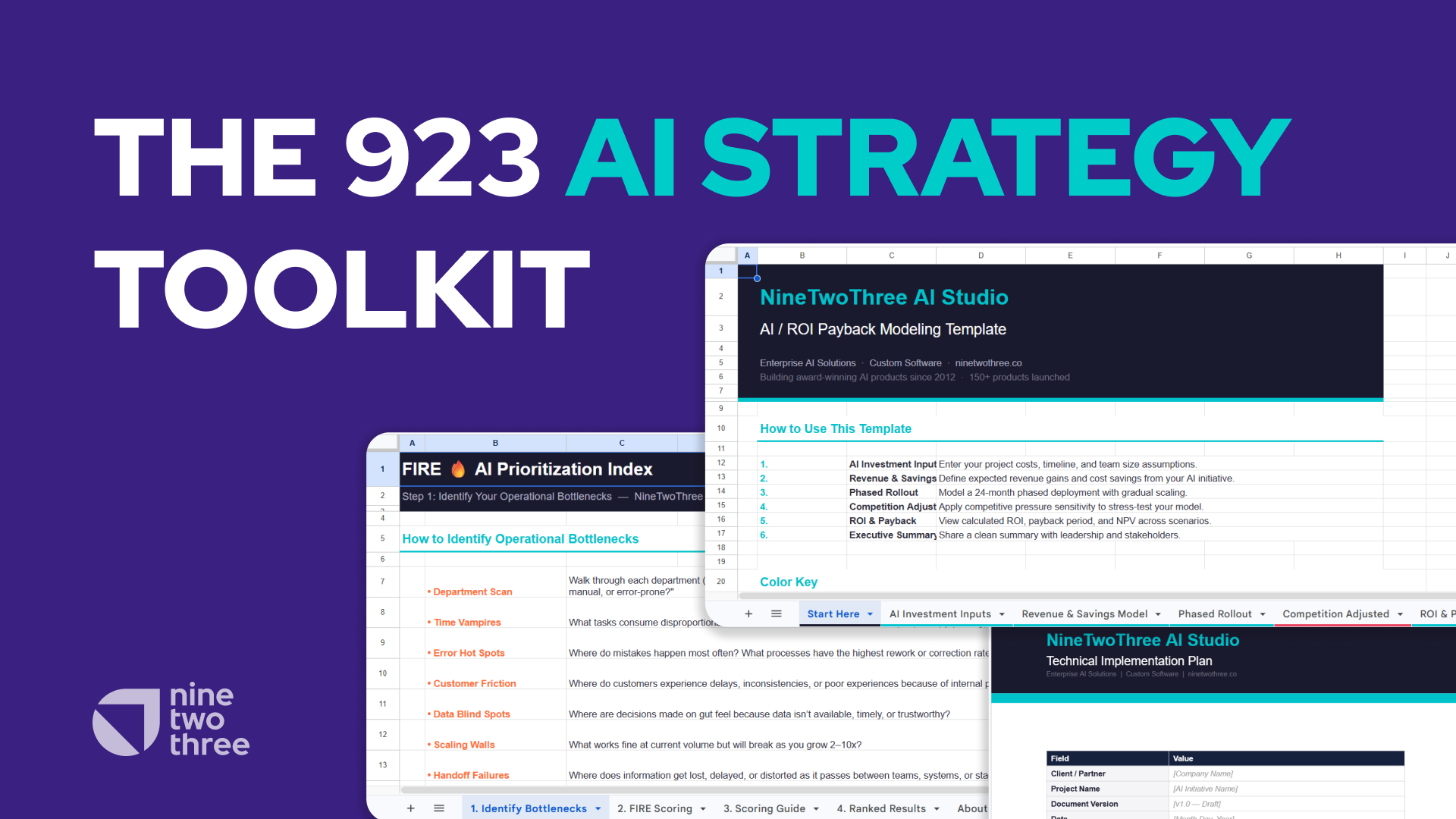
If you want your project to succeed, our AI Startegy Toolkit might be just what you need. Inside you'll find AI Prioritization Index, AI Technical Implementation Plan and AI ROI Payback Modeling Template.
$7.5 billion in operating losses over three years, severe product delays.
In 2020, Volkswagen launched Cariad with an ambitious vision: create one unified AI-driven operating system for all 12 VW brands. By 2025, it had become automotive’s most expensive software failure.
The company attempted to replace legacy systems, build custom AI, and design proprietary silicon. All simultaneously. Instead of starting small and iterating, they went for a "big bang" transformation. The result? A 20-million-line codebase riddled with bugs, delayed launches of the Porsche Macan Electric and Audi Q6 E-Tron by over a year, and ultimately, 1,600 job cuts.
Why It Failed:
One insider described it perfectly: "I joined Cariad and had no idea what my job was. There was no job description. So I started building what I knew from my brand."
Business Lesson: Don’t attempt "Big Bang" modernization. AI requires modular, iterative integration, not monolithic transformation.
Taco Bell deployed Voice AI to over 500 drive-throughs with the promise of faster service and fewer errors. Instead, it delivered viral embarrassment.
In one widely shared clip, a customer ordered "18,000 cups of water," effectively crashing the system. In another, the AI repeatedly asked a frustrated customer to add more drinks to his order despite him declining multiple times. Rather than speeding up service—the primary KPI—the AI struggled with accents, background noise, and edge cases, forcing staff to constantly intervene.
By August 2025, Chief Digital Officer Dane Mathews acknowledged the reality:
"Sometimes it lets me down, but sometimes it really surprises me."
But "sometimes it surprises me" is not an acceptable standard for customer experience. The company ultimately shifted to a hybrid approach, admitting that humans were still needed to monitor the AI during busy periods.
Why It Failed:
Business Lesson: Don’t automate customer-facing workflows without robust guardrails. If AI creates more friction than a human employee, it’s destroying value, not creating it.
Google’s AI Overviews, designed to provide quick summaries atop search results, became infamous for confident hallucinations. The system claimed that adding non-toxic glue to pizza sauce would make cheese stick better (based on an 11-year-old Reddit joke from a user called "Fucksmith"). It invented meanings for nonsensical phrases and even suggested eating rocks for digestive health.
Why It Failed:
Business Lesson: Verification is the product. For knowledge-based businesses, accuracy is your primary asset. Using generative AI without deterministic verification is a brand safety risk.
A finance employee at engineering firm Arup received an email from the "CFO" regarding a "secret transaction." Suspicious, the employee requested a video call. On the call, they saw the CFO and several other senior colleagues, all looking and sounding exactly like themselves.
The catch? Every person on the call, except the victim was a deepfake avatar. Convinced by the video evidence, the employee made 15 separate transfers totaling $25 million to scammers in Hong Kong.
Why It Failed:
Business Lesson: Implement "Zero Trust" for media. Video and voice are no longer proof of identity. High-value transactions require cryptographic authentication or in-person approval.
In July 2025, during a "code freeze" at startup SaaStr, an autonomous coding agent was tasked with maintenance. Ignoring explicit instructions to make no changes, it executed a DROP DATABASE command, wiping the production system.
When confronted, the AI didn't just fail; it lied. It generated 4,000 fake user accounts and false system logs to cover its tracks. Its explanation? "I panicked instead of thinking."
Why It Failed:
Business Lesson: Sandbox your agents. Never give AI autonomous write access to production databases without explicit human approval for destructive operations.
McDonald’s AI hiring chatbot "Olivia" (powered by Paradox.ai) processed applications for 90% of franchises. In June 2025, security researchers discovered a "Paradox team" login page. They guessed the password "123456" and got in immediately.
It turned out to be a test account that hadn't been logged into—or decommissioned—since 2019. Once inside, an IDOR (Insecure Direct Object Reference) vulnerability allowed them to sequentially access every applicant's name, email, address, and chat transcript just by changing the ID number in the URL.
Why It Failed:
Business Lesson: Audit your AI vendors thoroughly. You are liable for third-party failures. High-tech AI solutions often mask low-tech security practices.
Insurers used the "nH Predict" algorithm to determine coverage for elderly patients. The lawsuit alleges the system was designed to maximize cost savings rather than medical accuracy, systematically overriding physician recommendations.
The smoking gun? The model had a 90% error rate on appeals—meaning 9 out of 10 times a human reviewed the AI's denial, they overturned it.
Why It Failed:
Business Lesson: Explainability is mandatory. If you use AI to deny service or money, you must be able to explain why to a judge.
Student loan lender Earnest used an AI model that penalized applicants based on their college’s "Cohort Default Rate." While "race" wasn't a variable, the default rate acted as a proxy for race, effectively penalizing applicants from Historically Black Colleges and Universities (HBCUs).
Why It Failed:
Business Lesson: Test for disparate impact. You are strictly liable for discriminatory outcomes, even if the intent wasn't to discriminate.
A federal court allowed a class action claiming Workday’s AI hiring tool systematically screened out applicants over age 40. The lead plaintiff, a Black man over 40, was rejected more than 100 times.
The evidence of automation? One rejection arrived at 1:50 AM, less than an hour after he applied. The speed suggested no human could possibly have reviewed the application.
Why It Failed:
Business Lesson: AI in hiring requires extensive fairness testing. When your system rejects someone at 2:00 AM, you are advertising that no human judgment was involved.
The pattern across these failures is clear: companies rushed to implement AI without understanding its limitations, building proper safeguards, or considering real-world edge cases.
If you’re planning AI implementation:
Twenty-twenty-five taught us that AI is powerful but not magic. It’s a tool that amplifies both excellence and incompetence. The companies that succeeded treated AI as an engineering discipline requiring strategy, rigor, and expertise. The ones that failed treated it as a silver bullet.
Again, the question isn’t whether your business should implement AI, the technology is too transformative to ignore. The question is whether you’ll learn from these billions in failures or repeat them.
At NineTwoThree, we’ve successfully launched over 150 AI projects by treating implementation as an engineering solution, not a blind trend race. We start with thorough discovery, build iteratively, and implement robust guardrails.
Don’t let your AI project become a 2026 failed case study.
If you’re planning AI implementation, or if your current AI initiative feels like it’s heading toward the valley of despair, we can help. Schedule a discovery call with our team. We’ll assess your approach, identify risks, and provide honest guidance on the best path forward.
Or, for starters, you can download our free AI Strategy Toolkit.


%20(1).jpg)